


Phone:
+86-15928560945
This article is the first part of a series on Japan’s emergency broadcasting system.
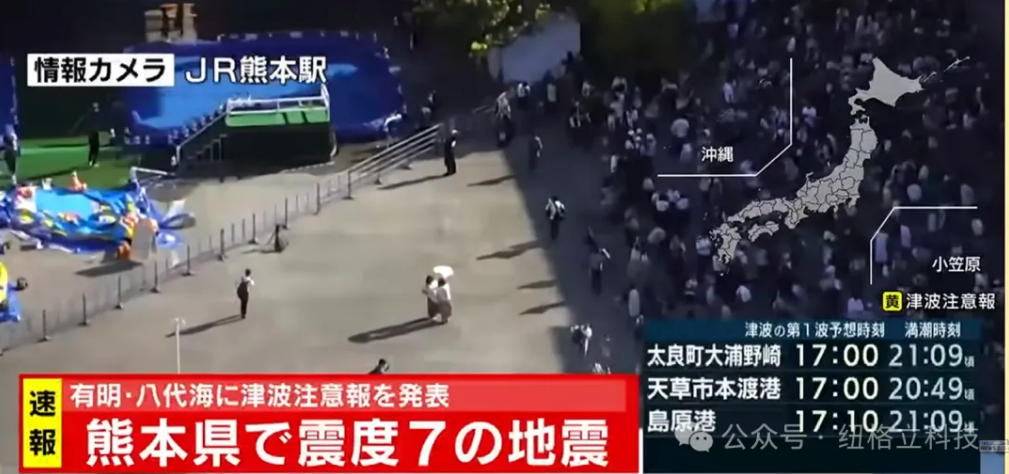
▲ Caption: On July 28, 2026, seismic intensity 7 was recorded in Uki City and Hikawa Town, Kumamoto Prefecture.
The Kumamoto earthquake of July 28, 2026 provided a rare opportunity to observe the system in action: the same warning was delivered to the same population at virtually the same moment through several independent communication channels.
At 4:27 p.m. on July 28, 2026, a fault more than ten kilometers beneath the Kumamoto region of Kumamoto Prefecture ruptured, releasing a magnitude 7.1 earthquake.
Approximately 3.8 seconds after the monitoring network detected the first weak seismic waves, the Japan Meteorological Agency issued its initial Earthquake Early Warning. By 5.5 seconds, the warning area had expanded to cover the entire Kyushu region.
Uki City and Hikawa Town eventually recorded a seismic intensity of 7, the highest level on Japan’s seismic intensity scale.
Every step during those few seconds was completed by machines.
Primary waves travel faster than secondary waves. The small amount of time gained from that difference is only enough to run through a fixed procedure once: calculate the epicenter, estimate the magnitude, predict the seismic intensity in different locations, and issue an alert when the predefined threshold is exceeded.
Whether an alert should be issued, whether an ongoing television or radio program should be interrupted, and which regions should receive mobile warnings are all determined by preset rules.
Human involvement comes afterward, when experts review whether the system’s calculations and predictions were accurate.
After the Earthquake Early Warning was issued by the Japan Meteorological Agency, it entered two completely different systems.
One route went through television and radio.
Japanese television and radio broadcasters respond automatically to this type of signal. When an earthquake is expected to reach seismic intensity 5-lower or above, the program currently being broadcast is immediately interrupted. A map and countdown appear on the screen, accompanied by the standard warning tone.
At the interface level, the process is automatic. Once the signal arrives, the system switches to the emergency broadcast without waiting for approval from the newsroom or editorial staff.
The second route went through mobile phones using cell broadcast technology.
The term can easily be misunderstood as meaning that a text message is sent individually to every mobile user. Conventional SMS messages must be delivered one by one. Sending one million messages would require establishing one million separate connections.
During a disaster, when the network is already congested, this method would be both slow and capable of overwhelming the network.
Cell broadcast works differently.
A mobile base station broadcasts the warning directly throughout its coverage area. It does not matter how many phones are present, and no list of phone numbers is required. Any compatible device that is powered on and connected to the local cell can receive the message.
The mobile operator does not know exactly who received the alert, nor does it need to know.
In Japan, this channel is known as the Emergency Warning Email system. It was introduced in 2007 and is supported by all three major mobile network operators. It is one of the earliest and most comprehensively deployed cell broadcast systems in the world.
These two channels are different implementations of the same principle: one-to-many, one-way communication without establishing individual connections, regardless of who the recipients are or how many people are listening.
That is the original meaning of the word “broadcast.” Radio is only one of its many possible carriers.
The destruction arrived shortly afterward.
The second floor of AEON Mall Kumamoto collapsed and an explosion occurred, leaving people trapped. Approximately 40,000 households lost power.
At 4:29 p.m., the Japan Meteorological Agency issued a tsunami advisory for the Ariake Sea and Yatsushiro Sea. The advisory was lifted at 6:10 p.m.
Dozens of people were killed, and the casualty figures continued to rise during the two days following the earthquake. By 3:00 p.m. on July 30, Kumamoto Prefecture had opened 406 evacuation shelters, accommodating 9,450 people.
These were conventional disaster statistics and were not fundamentally different from those recorded after other major earthquakes in Japan over the past several decades.
What made this event unusual was the relatively complete record it left behind of the routes taken by the warning—and which of those routes failed along the way.
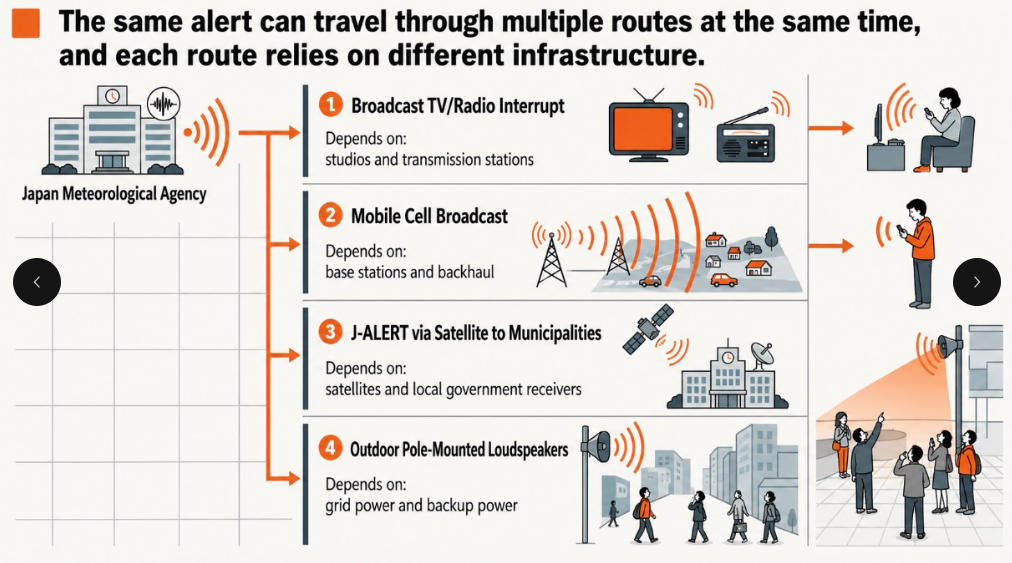
▲ Caption: The same alert travels through several routes at the same time, with each route relying on different infrastructure.
Within minutes of the earthquake, communication networks began to experience failures.
NTT Docomo is Japan’s largest mobile operator by subscriber numbers. Its parent company, NTT, was created through the privatization of Nippon Telegraph and Telephone Public Corporation and has long played a central role in Japan’s national communications infrastructure.
From 4:27 p.m., both voice and data services became unavailable in parts of Yatsushiro City and Uki City.
KDDI began reporting outages at 4:28 p.m., affecting parts of Yatsushiro City, Hitoyoshi City, Uki City, and Misato Town in Shimomashiki District.
Rakuten Mobile continued to experience service disruptions from July 29 onward.
The causes included power failures at base stations and damage to transmission lines. In some areas, even emergency calls could not be made.
SoftBank’s network did not fully return to normal until 12:47 p.m. on July 30.
During the outages, Docomo and KDDI activated reciprocal JAPAN Roaming arrangements, allowing customers of one operator to connect temporarily through the other operator’s network.
The operators also opened the 00000JAPAN public wireless LAN service, allowing people to access participating Wi-Fi networks without a password.
In the area where seismic intensity 7 was recorded, mobile communication remained unavailable for more than two days.
Japan’s cell broadcast system was one of the earliest and most thoroughly deployed in the world. There was little to criticize about its delivery speed or device compatibility. At 4:27 p.m., it did successfully send the warning.
But base stations need electricity and transmission links. Backup generators need fuel, and someone has to refill them. Damaged fiber-optic cables need to be physically repaired.
As a result, cell broadcast was the fastest channel during the first second of the disaster, but by the following day it had become the first channel to go dark.
The problem lay in the dependency chain.
Cell broadcast shares critical points of failure with the electricity grid and terrestrial transmission network. The defining feature of a major disaster is that these systems often fail together across a wide area.
After the mobile networks went offline, two types of systems continued to distribute information.
The first was the municipal disaster-prevention administrative radio system.
This is a dedicated wireless communication system operated by local governments. It is not a conventional radio station. The loudspeakers mounted on poles in streets and neighborhoods are its most visible endpoints.
The other endpoint is an indoor receiver installed in residents’ homes.
Usually placed in a living room or entrance hall, the device is similar in size to a small radio. When an emergency warning is issued, it activates automatically and begins broadcasting the message.
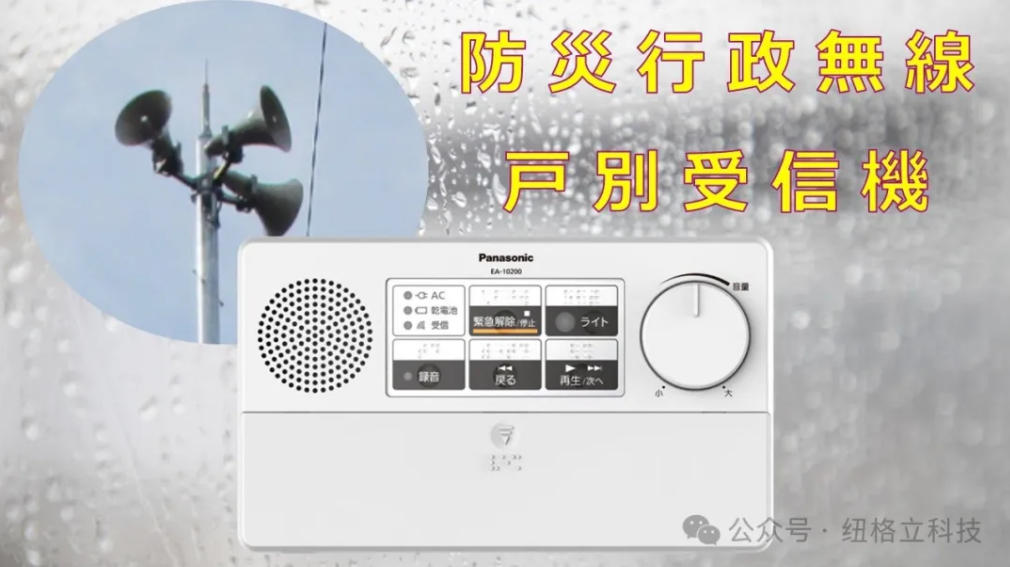
▲ Caption: Indoor receivers installed in residents’ homes address the problem of outdoor loudspeakers being difficult to hear in wind and rain or inside well-insulated homes. How widely they are deployed depends on how much local governments are willing to spend.
The signal can originate from a microphone at the municipal government office, or it can come from J-ALERT.
J-ALERT is Japan’s nationwide instantaneous warning system. Alerts issued by the Japan Meteorological Agency or the Cabinet Office are transmitted by communications satellite directly to receivers installed by municipalities.
The receiver can automatically activate outdoor loudspeakers, interrupt local cable broadcasts, and distribute local government emails. No staff member needs to press a button anywhere in the chain.
Tsunami warnings issued late at night depend on this automation because municipal offices may not have personnel actively monitoring the system at that hour.
The advantage of this layer is that it has backup power and does not depend on mobile networks or terrestrial transmission infrastructure.
Its weakness is that outdoor loudspeakers can be difficult to hear during heavy rain or strong winds. They are even more difficult to hear inside tightly sealed modern homes.
Japan has debated this problem for many years. The adoption rate of household receivers still varies significantly from one municipality to another.
The second category consisted of radio and television broadcasters.
NHK immediately switched to special disaster coverage. Its 7:00 p.m. news program was extended until 8:45 p.m., and scheduled entertainment programming was cancelled.
Commercial broadcasters also moved to emergency schedules. RKK Kumamoto Broadcasting produced special programming and distributed it online at the same time.
In the Kumamoto area, residents could receive RKK on its 1197 kHz AM frequency, through its 91.4 MHz FM supplementary relay station, through NHK Kumamoto’s AM and FM broadcasts, and through online distribution on Radiko.
FM supplementary relay stations are retransmission facilities that Japan has introduced in frequencies above 90 MHz in recent years to improve reception in areas where AM signals are weak. They will be discussed in more detail later in this series.
Online broadcasting, however, runs on the internet.
The internet, in turn, depends on many of the same mobile base stations and fiber-optic cables that had already failed.
Radiko remained useful outside the disaster zone. In the towns and municipalities where internet access had been lost, it went silent along with the mobile phones.
Japan also operates a system known as the Emergency Warning Broadcasting System, which can automatically switch on compatible televisions and radios that are in standby mode.
Its activation conditions are strictly defined.
A tsunami warning can activate the system. An evacuation instruction issued at the request of a municipal mayor can also activate it.
In this earthquake, however, the Japan Meteorological Agency issued a tsunami advisory rather than a tsunami warning. Under the established rules, an advisory does not activate the automatic wake-up system.
This created a striking situation.
The earthquake had already reached seismic intensity 7, the maximum level on Japan’s scale, yet the system specifically designed to wake people during a major emergency probably remained inactive because the event did not meet its formal trigger conditions.
This was not a malfunction. It was a predefined boundary in the rules.
The dividing line between a tsunami warning and a tsunami advisory is based on expected tsunami height, not on the seismic intensity of the earthquake.
Tsunami height and the destructive force of ground shaking are two different things.
The Emergency Warning Broadcasting System has been in operation since 1985.
Japan has never placed its entire emergency warning capability on a single communication channel.
The alert calculated by the Japan Meteorological Agency was simultaneously sent into television and radio interruption systems, the cell broadcast networks of three mobile operators, the satellite-based J-ALERT system, municipal outdoor loudspeakers, local government email systems, and mobile applications.
These channels use different technologies, belong to different organizations, and depend on different types of infrastructure.
Television and radio interruption systems depend on studios and transmission stations.
Cell broadcast depends on mobile base stations and backhaul connections.
J-ALERT depends on satellites and municipal receivers.
Outdoor loudspeakers depend on the pole on which they are mounted and the batteries installed beside them.
Because these systems are independent of one another, it is difficult for a single earthquake to disable all of them at the same time.
In this earthquake, the fastest channel was knocked offline. The remaining channels continued operating throughout the two days in which the mobile network was unavailable.
This is a classic example of redundant system design.
The same function is built five times. Each layer is maintained separately, tested separately, and evaluated separately.
Redundancy provides the reserve capacity that allows a system to continue operating after part of it has been damaged.
The price is lower efficiency during normal times.
Japan has paid that price for forty years.
Throughout that period, people have repeatedly questioned whether such systems are too expensive. Those objections are always louder during years when nothing happens.
Japan does not have many years in which nothing happens.
So the system has continued to be built.


