



Phone:
+86-15928560945
In the previous articles of this series, we demonstrated the necessity of incorporating digital radio into mandatory national automotive standards from seven dimensions: policy benchmarking, cost breakdown, rigid emergency demand, industrial driving force, functional display, negative lessons, and technical comparison.
But all these arguments point to the same premise: Can the supply chain support it?
If only one foreign supplier can produce automotive-grade digital radio chips, then "mandatory implementation" means "mandatory reliance"—which is unacceptable in the context of China's current industrial security.
The good news is: The reality of the supply chain is much better than most people imagine.
This article reviews the global supplier landscape for automotive radio chips and modules, from the RF front-end to the digital baseband and the software stack, to see exactly what is needed to put "digital radio in cars," who is building it, and how far along they are.
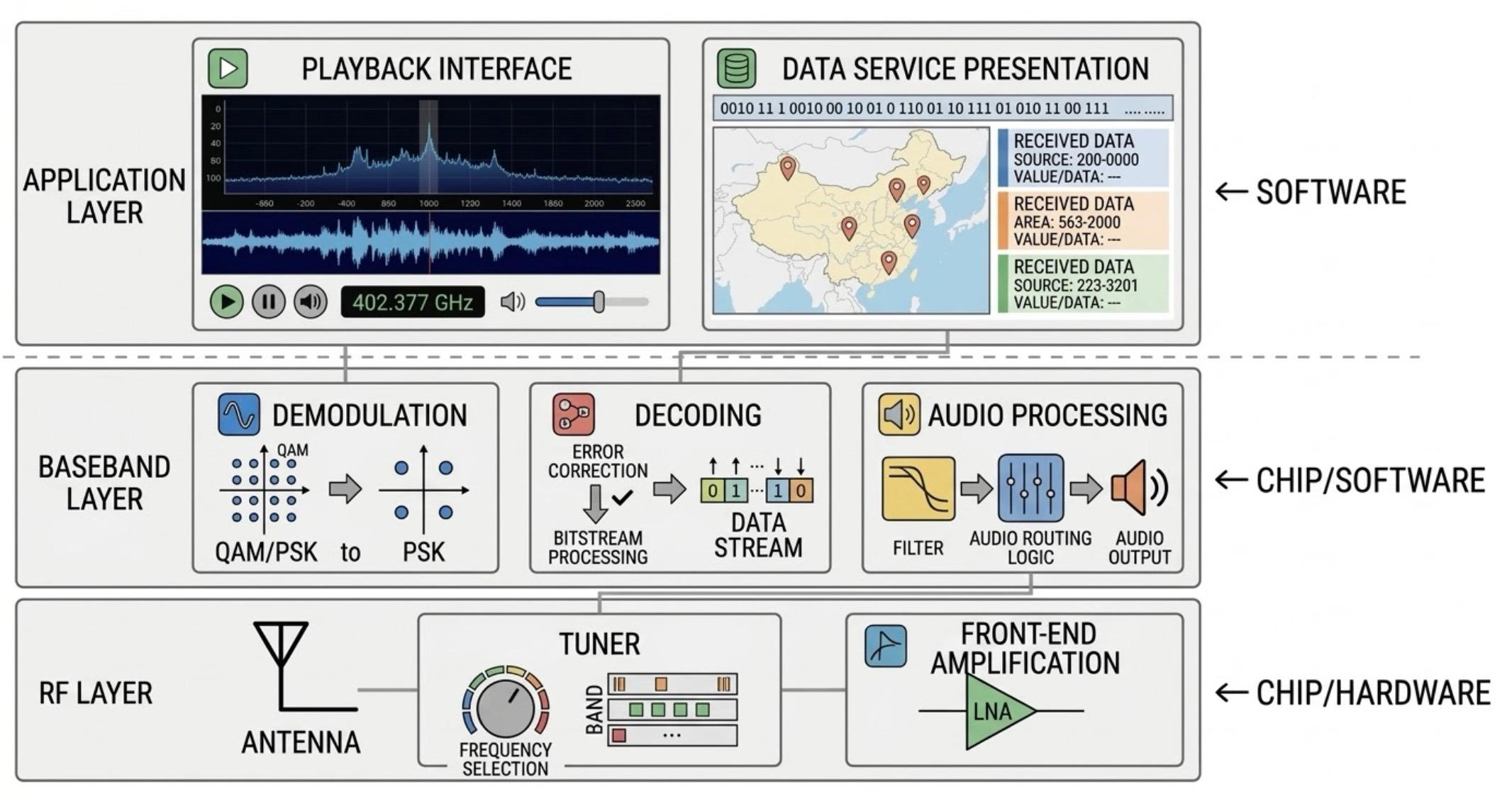
Whether it is analog FM or digital DRM/CDR, an automotive radio reception system can be broken down into three layers:
RF Layer: Responsible for receiving signals from the antenna, frequency selection, and amplification. This layer differs little between analog and digital solutions; the core component is the automotive-grade tuner chip.
Baseband Layer: The watershed between analog and digital. Analog FM only requires simple demodulation and stereo decoding. Digital radio, however, requires complex processing such as OFDM demodulation, channel decoding (Viterbi/LDPC), and audio decoding (USAC/DRA+). This layer can be implemented using a dedicated SoC (System on Chip) or a general-purpose processor paired with software (the SDR path).
Application Layer: The user interface—playback control, station lists, text information display, and emergency warning presentation. This layer is entirely software.
Understanding this three-tier architecture reveals a key fact: putting digital radio in cars is not about building a "completely new system," but rather adding/replacing the baseband layer's processing capabilities within existing automotive audio systems. The RF front-end can be heavily reused, and the application layer can be developed on existing infotainment platforms. The true incremental change lies in that middle layer.
The market for automotive-grade radio tuner chips is dominated by three companies, and the landscape has been stable for years:
NXP Semiconductors (Netherlands): NXP is the absolute leader in automotive radio chips. Its product line covers everything from entry-level FM to high-end multi-standard digital radio needs. At CES 2017, NXP released the SAF4000 series—the world's first all-standard automotive digital radio single-chip solution, integrating up to four tuners in one RFCMOS device, supporting all AM/FM, DAB/DAB+, DRM/DRM+, and HD Radio standards. This series features different configurations for different markets: DAB+ for Europe, and CDR/DRM for China and India—using the same hardware platform to switch standards via software configuration. NXP is also advancing next-generation platforms to further enhance integration and audio processing.
Skyworks Solutions (USA, formerly Silicon Labs' automotive division): Skyworks acquired Silicon Labs' infrastructure and automotive business in 2021, inheriting a shipping record of over 275 million automotive tuners globally.
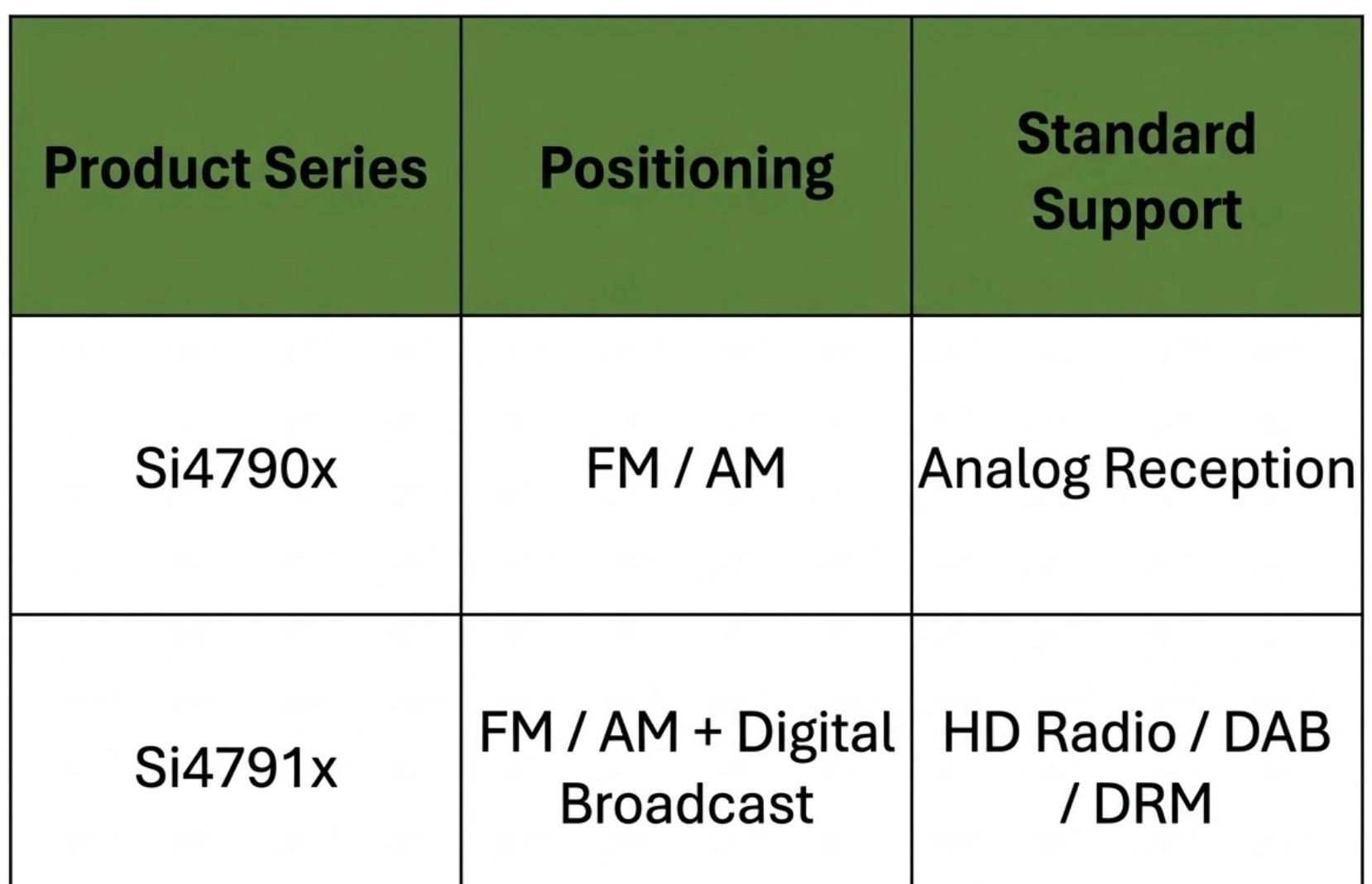
The Si4790x series is a purely analog solution, known for extremely high integration and low peripheral component counts. The Si4791x builds on this by adding digital radio coprocessing, supporting HD Radio, DAB, and DRM. Skyworks excels in the analog FM sector, but its product line breadth and adaptation to the Chinese market in digital radio are not as extensive as NXP's.
STMicroelectronics (Europe): ST has served European automakers for years through its TDA series.
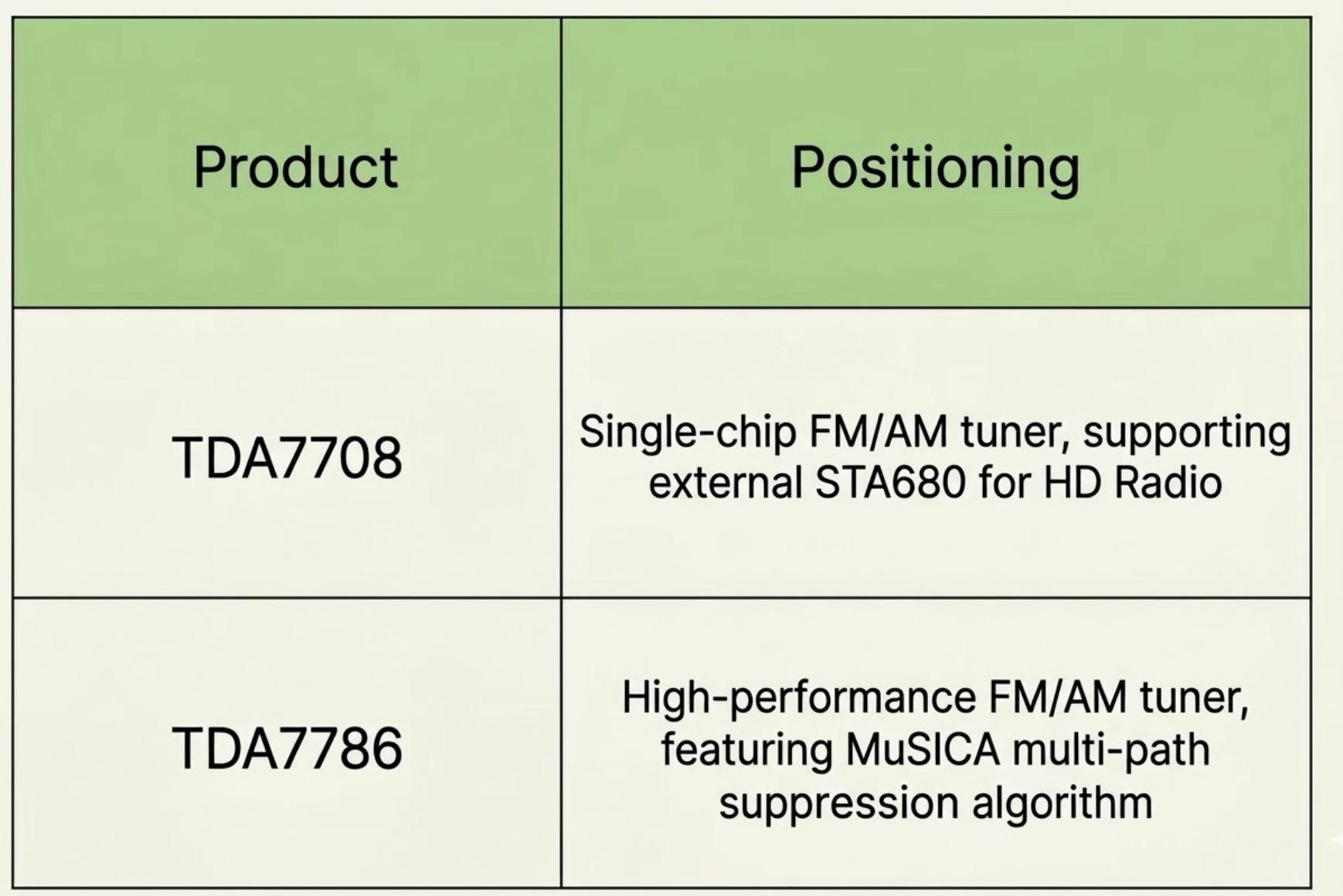
Its strength lies in analog FM tuning performance and deep supply chain relationships with European car companies (like Volkswagen and PSA). In terms of digital radio SoCs, ST is not as comprehensive as NXP, but its tuners can serve as front-ends paired with other digital baseband solutions.
Chinese Players: QX300/QX201C
It is worth noting that China already has FM/AM tuner chips that have passed AEC-Q100 automotive-grade certification—the QX300 and QX201C, developed and produced by a subsidiary of a state-owned enterprise group.
These chips support global FM/AM/LW/SW bands and RDS decoding, are pin-to-pin compatible with Silicon Labs' Si4755/Si4763, and require only minor software adaptation to replace them. Operating from -40°C to +105°C with a signal-to-noise ratio of 72dB, they have already entered mass production for several automakers. Reports indicate a localization rate of over 95% and costs roughly 40% lower than imported solutions.
Currently, the QX300/QX201C cover analog FM/AM tuning and have not yet integrated digital radio baseband processing. But their existence proves a key point: domestic substitution of automotive-grade tuner chips is no longer a question of "can it be done," but "it is already being done."
The RF tuner chip is not a "chokepoint" for three reasons:
1.Multi-supplier landscape: Three major companies compete; there is no single monopoly.
2.Manageable technical barriers: Automotive-grade tuners do not require highly advanced manufacturing processes (65nm/28nm is sufficient); domestic foundries are fully capable of producing them.
3.Can be bypassed via SDR: Under a pure software SDR architecture, the RF front-end can be replaced by general-purpose ADCs + LNAs instead of relying on dedicated tuner chips.
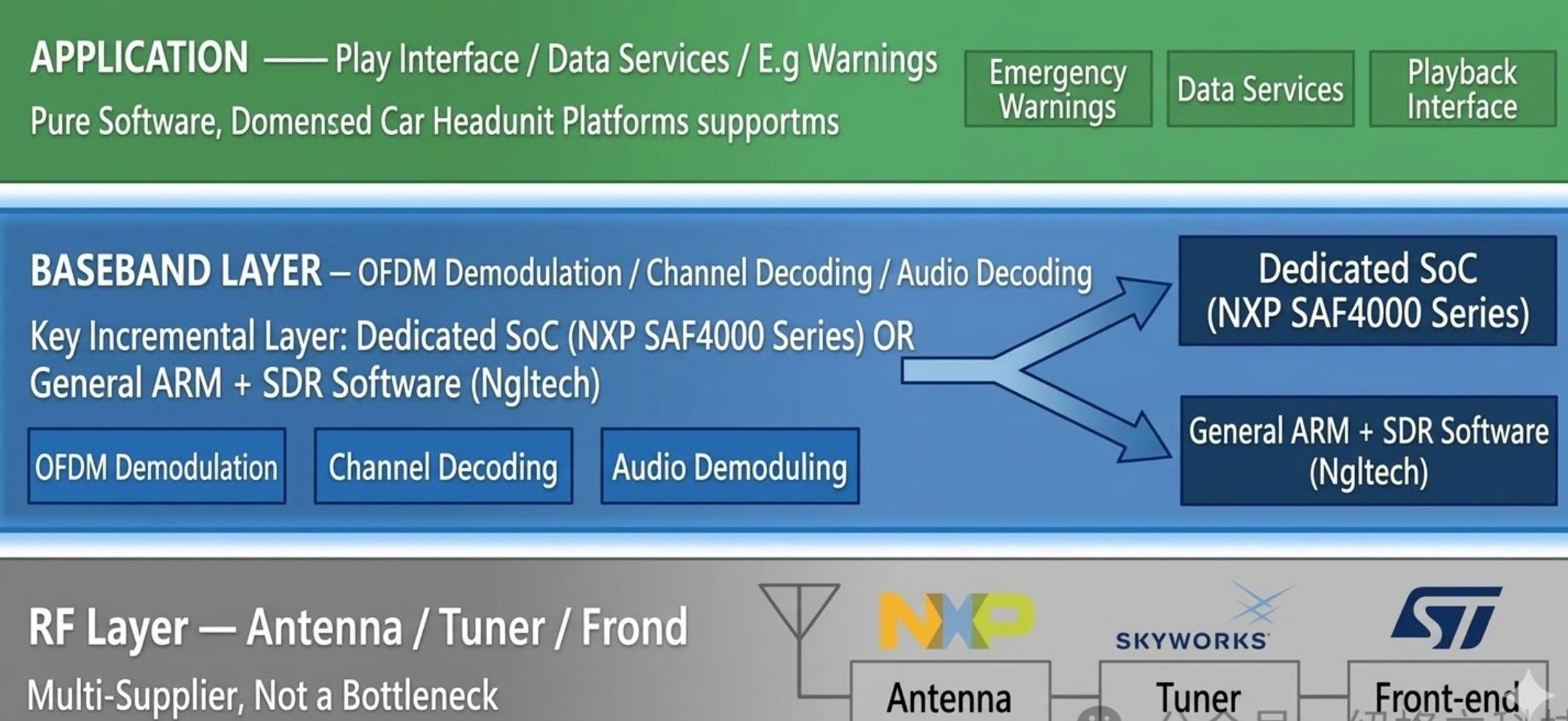
(Image Caption: The three-tier architecture of automotive radio reception—the digital radio increment is concentrated in the baseband layer)
The baseband layer is the core addition for bringing digital radio to cars, and the focal point of the "Can China do it?" question. Currently, there are two technical paths:
Path 1: Dedicated SoC
Represented by the NXP SAF4000 series. It integrates the tuner, baseband processing, and audio decoding into a single chip, offering the highest hardware efficiency, lowest power consumption, and simplest BOM (Bill of Materials).
Advantage: Mature mass production, complete automotive certification, and verification across tens of millions of vehicles globally. Skyworks' Si469xx series coprocessors also support DRM and CDR decoding and can pair with Si4790x tuners, providing a secondary supplier option.
Disadvantage: For complete CDR/DRM automotive solutions, the NXP SAF4000 series remains the primary choice, leading to high supplier concentration.
Path 2: General Processor + SDR Software
Represented by Ngltech's full-chain automotive solution, slated for release at CCBN 2026. On a general ARM embedded processor, all DRM, CDR, AM, and FM reception functions are implemented purely through software—without relying on any dedicated radio chip.
The logic here is that DRM and CDR baseband processing (OFDM demodulation, Viterbi/LDPC decoding, USAC/DRA+ audio decoding) are fundamentally mathematical operations. They can be implemented via software on any processor with sufficient computing power. This is the core philosophy of Software Defined Radio (SDR).
Ngltech's solution supports:
Full-band DRM (Modes A-E, DRM30 + DRM+)
Full CDR configurations (GY/T 268 series, three transmission modes, six spectrum configurations)
Analog AM/FM reception
EWF emergency warnings + GY/T 403-2024 CDR emergency broadcasting
Data services like structured text information, MOT SlideShow, and station logos
Adaptation for ARM embedded platforms
The strategic significance of the SDR path is that it shifts digital radio capabilities from "hardware binding" to "software defined." Any automotive-grade ARM processor meeting the computing requirements—and China has many mature automotive-grade SoC suppliers (such as SemiDrive, SiEngine, Rockchip, Allwinner)—can serve as a carrier for digital radio.
Generalized hardware, software-defined capabilities. This is the technical path to fundamentally eliminate supply chain risks.
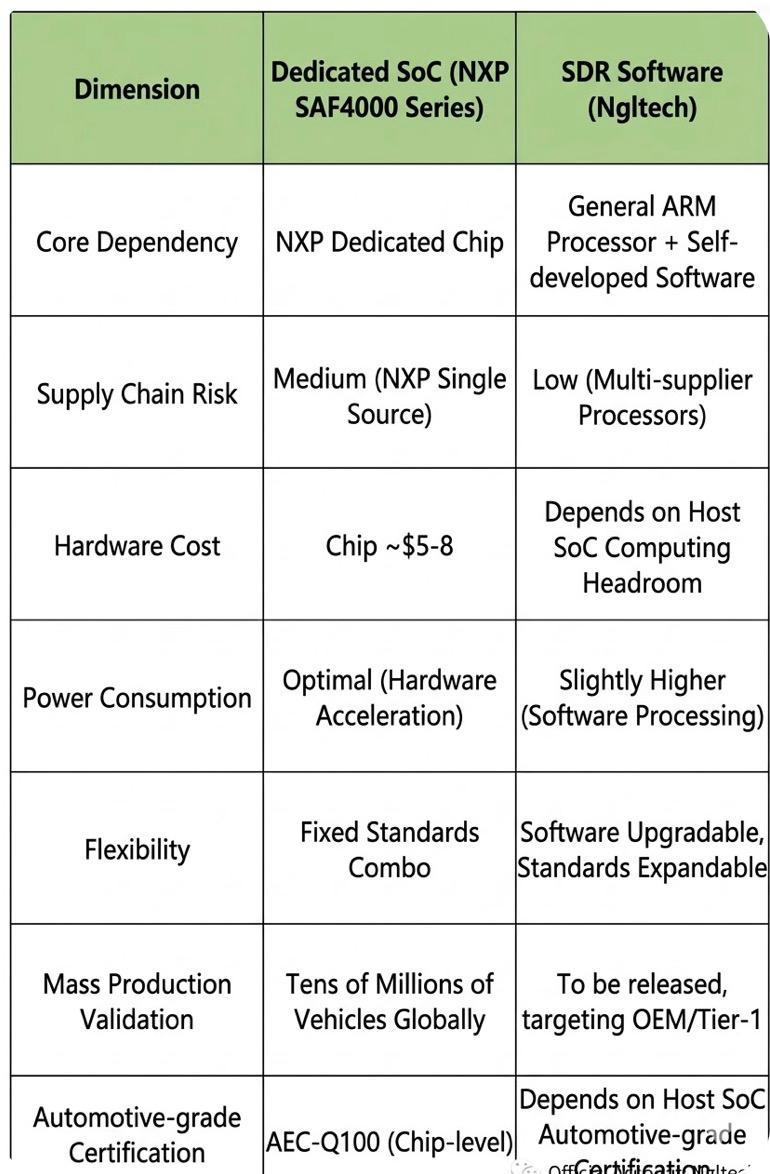
The two paths are not mutually exclusive. In the early stages of the industry, dedicated SoC solutions (NXP SAF4000) can rapidly scale up and reduce integration risks. In the medium to long term, SDR solutions can gradually replace them to achieve complete localization. Using mature solutions to open the market first, then using independent solutions to secure the supply chain—this is the most pragmatic industrial strategy.
The application layer—playback interfaces, data service presentation, and emergency warning interactions—is entirely software development.
China's In-Vehicle Infotainment (IVI) industry is highly mature. Whether based on Android Automotive, Linux, or QNX platforms, the technical barrier to developing a digital radio playback app is far lower than developing a navigation app or a voice assistant. Ngltech concurrently provides accompanying multimedia radio playback software, supporting Web UI, native desktop GUI solutions, and Linux/Android platforms, to fully render all digital radio content components.
There are absolutely no supply chain bottlenecks in the application layer.
An often-overlooked fact: adding digital radio to cars does not require additional antennas.
DRM uses medium/shortwave bands (same as AM), and CDR uses the FM band (88-108MHz, same as FM). Existing vehicle AM/FM antennas—whether shark fin, roof-mounted rod, or window-printed antennas—can receive digital radio signals without any modifications. This is frequently missed in cost discussions. The increment for digital radio is entirely internal to the head unit; the antenna cost increment is zero.
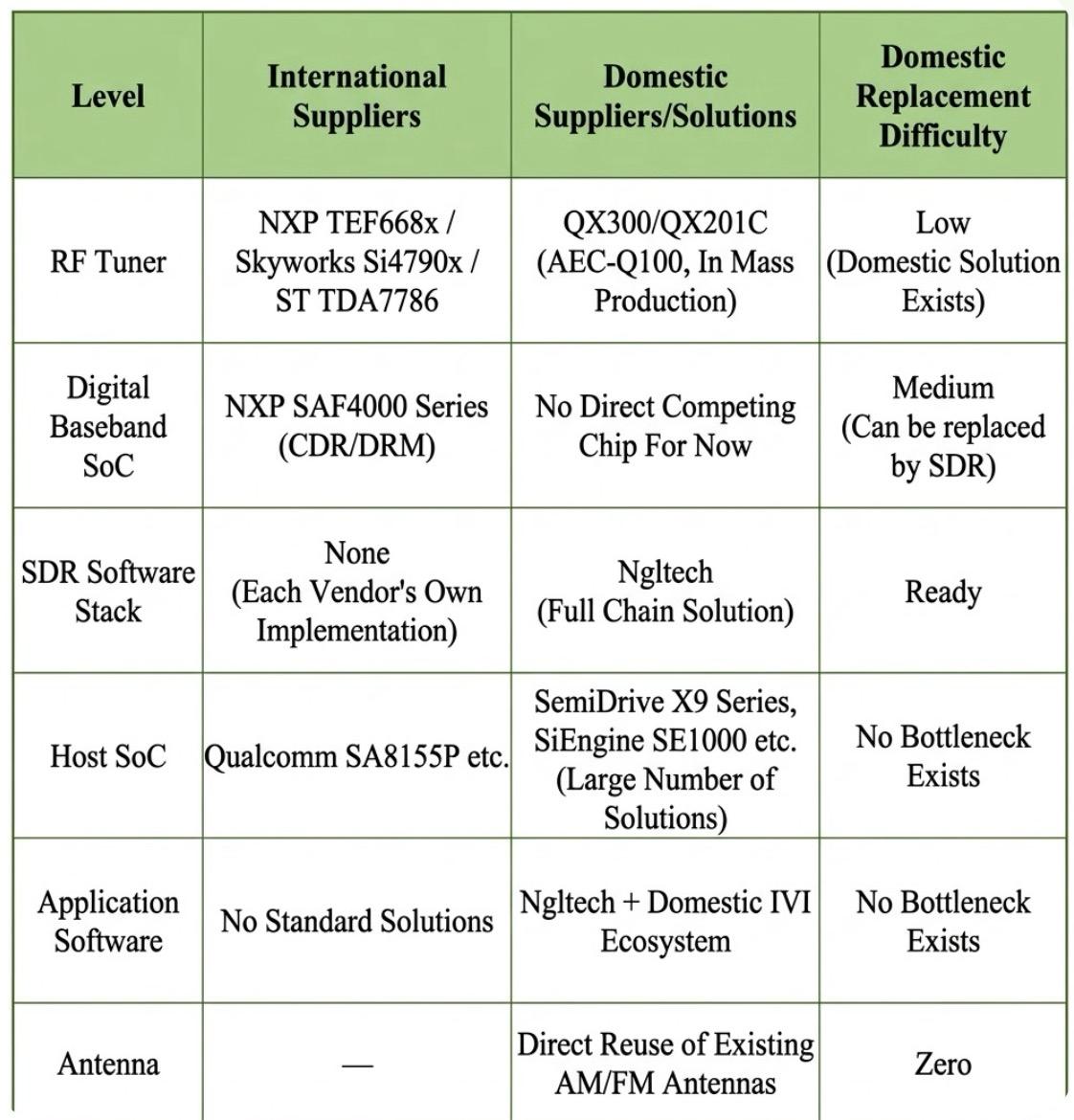
If we map out the supplier landscape across these architectural layers, out of six key links:
Two already have fully domestic solutions (SDR software stack, application software).
One requires absolutely no change (Antennas).
One has a large number of domestic suppliers (Host SoC).
Two currently rely on international suppliers but can be bypassed via the SDR path (RF tuner, digital baseband SoC).
Not a single link is a true "chokepoint." In a worst-case scenario (international supply chain disruption), a purely domestic SDR solution + domestic ARM SoC + existing antennas can realize complete digital radio reception. In the best-case scenario, international chips and domestic software can complement each other, forming a healthy multi-supplier ecosystem.
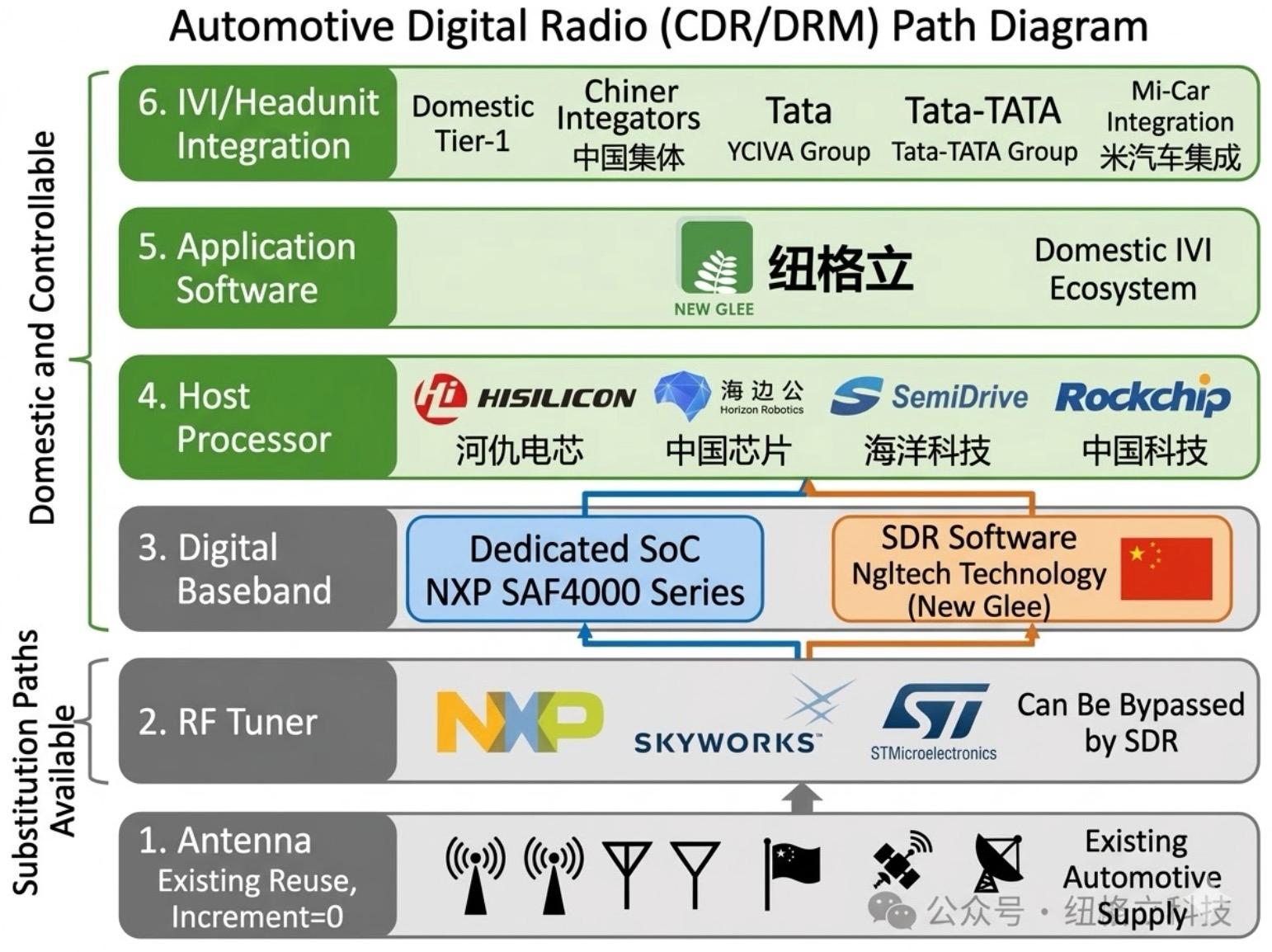
(Image Caption: Panorama of the automotive digital radio supply chain—there are no true "chokepoint" links)
Returning to the title's question: Is the supply chain ready?
The answer is: It is technically ready; production capacity is just waiting for the starting signal.
NXP's SAF4000 series is already in mass production. Skyworks and ST's tuners are already installed in hundreds of millions of cars, and Skyworks' Si469xx coprocessors already support DRM and CDR decoding. The domestic QX300/QX201C tuners have passed automotive certification and entered mass production. Ngltech's full-chain SDR solution will soon be released at CCBN. Domestic automotive-grade ARM SoCs are mature. Antennas don't need to be touched.
What's missing is not chips, software, antennas, or production capacity.
What is missing are orders.
Without confirmed market demand, NXP will not optimize the CDR configuration and pricing of its SAF4000 series for the Chinese market. Without confirmed installation volumes, Ngltech's SDR solution cannot enter automakers' PPAP (Production Part Approval Process). Without confirmed national standard requirements, Tier-1 suppliers will not invest resources into developing integrated solutions.
There is an ironclad rule in the chip industry: Demand creates supply, not the other way around. The EU's EECC mandate doubled DAB+ chip shipments within two years. India's AIR DRM deployment led NXP and Mobis to establish local design centers in India.
With 30 million passenger vehicles sold annually, China's market volume is several times that of Europe and India. Once this volume is activated by national standards, the supply chain's response speed will only be faster—not three years, perhaps just one.
The day the words "digital radio" are written into the mandatory national standard will not be the ultimate test for the supply chain, but the firing of the starting gun.


