



Phone:
+86-15928560945
Before diving into solid-state, it is worth reviewing how tube transmitters work—after all, a large number of medium wave (AM) stations still rely on them.
The classic architecture of a tube AM transmitter is high-level plate modulation: the RF power amplifier (PA) stage uses one or more high-power tetrodes (like the 4CX20000) operating in a Class-C state. The modulator consists of another set of high-power tubes that superimpose the audio signal onto the plate (anode) power supply voltage of the RF PA stage. When the audio signal is high, the plate voltage increases, resulting in higher RF output; when the audio is low, the plate voltage drops, lowering the RF output. This is how amplitude modulation (AM) is achieved.
This architecture has been running for over half a century, but it has several unavoidable issues. The efficiency ceiling of a Class-C amplifier is around 60%. The modulation transformer—the massive iron core transferring audio power to the plate—can weigh anywhere from several tons to over ten tons (a single modulation transformer for the WLW 500kW transmitter weighed 37,000 pounds), and its hysteresis and saturation characteristics directly affect modulation linearity. The operating voltage of the entire machine reaches thousands to tens of thousands of volts. Furthermore, every tube has a limited lifespan and is quite expensive.
Solid-state transmitters solve these same problems using a completely different approach.
Take the Nautel NX series as an example. Inside an NX50 (a 50kW AM transmitter), there are 20 power amplifier modules, each with a rated power of 2,500W. These modules can be plugged and unplugged from the front panel of the cabinet. They are hot-swappable while the transmitter is on-air; the entire process takes about 5 minutes, and the only tool required is a screwdriver.
Each module is a complete RF power amplifier and modulator. It is not just an "amplifier board"; it simultaneously handles carrier amplification and amplitude modulation. Internally, each module has its own microcontroller that communicates with the main control system via a serial bus to handle local protection and report status.
The number of modules in the NX series scales linearly with power: the NX10 uses 4 modules, the NX25 uses 10, the NX50 uses 20, the NX100 uses 40, the NX200 uses 80, the NX300 uses 120, and the NX400 uses 160. A 2MW Solt system (five NX400s operating in parallel) has 800 modules working simultaneously. Every single one is an identical, standard component.
The RF PA section of the module employs a Class-D topology—an H-bridge (full bridge) circuit composed of four MOSFET switches.
The essence of Class-D is switching amplification. The four MOSFETs do not operate in their linear region; they only have two states: fully on or fully off. The two pairs of transistors on the diagonals conduct alternately. When Q1 and Q3 are on, current flows from left to right through the primary of the output transformer; when Q2 and Q4 are on, the current flows in the reverse direction. The output is a bipolar square wave with a frequency equal to the carrier frequency (e.g., 540 kHz).
A square wave is rich in odd harmonics (3rd, 5th, 7th...). A set of LC filtering networks is responsible for filtering out these harmonics while simultaneously matching the impedance with the combiner. The filtered output is a clean, sine wave RF carrier.
The core advantage of Class-D lies in its efficiency. The voltage drop of a MOSFET in its conducting state is extremely low (on-resistance is only tens of milliohms, and industrial-grade devices can be as low as a few milliohms), and the current is zero in the off state—an ideal switch produces no thermal dissipation. The actual RF efficiency at the module level can reach 98%. Compared to the 50%-60% of tube-based Class-C, this is a qualitative leap.
It is worth noting that the MOSFETs used in Class-D are standard power MOSFETs (usually N-channel vertical or trench structures), rather than the LDMOS devices commonly found in base stations and VHF/UHF transmitters. The reason is simple: the advantage of LDMOS lies in its high gain and broadband characteristics in linear amplification scenarios. However, in the pure switching topology of Class-D, lower on-resistance and faster switching speeds are what matter most, making standard power MOSFETs much more suitable and cost-effective.
How does a single module achieve both "amplification" and "modulation" simultaneously?
The answer is PDM—Pulse Duration Modulation, also known as Pulse Width Modulation (PWM). The principle consists of four steps:
1.Compare to generate pulses: The audio signal and a triangular reference wave are fed into a comparator. When the audio amplitude is high, the comparator outputs a wide pulse; when the amplitude is low, it outputs a narrow pulse. The width (duty cycle) of the pulse is proportional to the audio amplitude.
2.Switching modulation: The PDM signal drives a modulation-stage H-bridge, rapidly switching the DC power supply on and off.
3.Low-pass filtering to restore the envelope: The chopped square wave passes through a low-pass filter (cutoff frequency around 25-30 kHz, 4th-order Butterworth) to restore a smooth DC envelope voltage. The waveform of this voltage perfectly matches the audio waveform.
4.Envelope control of the RF PA: This varying DC voltage serves as the power supply for the RF Class-D H-bridge. The output amplitude of the H-bridge is proportional to its supply voltage. Because the supply voltage tracks the audio, the amplitude of the RF output follows suit. Amplitude modulation is complete.
This is fundamentally the same concept as high-level plate modulation in tube transmitters—using audio to control the supply voltage of the PA stage—but the implementation is entirely different. Tube transmitters use a modulation transformer (analog, bulky, non-linear), while solid-state transmitters use PDM (digital, precise, no magnetic saturation).
Nautel's NX series includes an ingenious optimization for PDM: Six-Phase PDM. An FPGA generates six PDM signals, each phase-shifted by 60 degrees, which are paired and distributed to adjacent modules (three phases to one module, three to another). When the switching noise of the six PDM phases combines at the summing point, lower-order harmonics are largely canceled out—similar to the harmonic cancellation principle in three-phase AC power. As a result, the spectral purity and audio linearity of the modulated output are significantly improved.
The PDM sampling rate reaches 1.8 Megasamples/second (2.7 MHz for the NX300), far exceeding the audio bandwidth. Pre-correction (AM-AM, AM-PM, envelope equalization) can also be applied in the digital domain to further compress distortion.
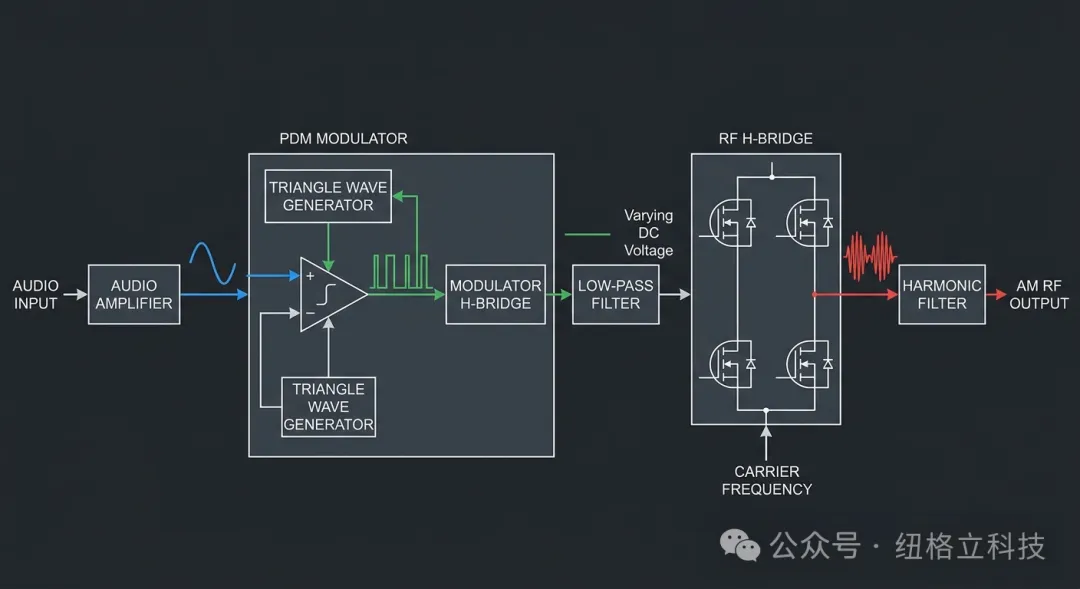
Figure Note: Signal flow of a solid-state medium wave transmitter power amplifier module. Audio → PDM Modulation → Envelope Voltage → Class-D RF PA → AM Output.
How are the outputs of 20 modules combined into a single signal?
Solid-state AM transmitters use series combining transformers (sometimes called "toroidal combiners"). The output of each module is connected to an independent primary winding on a shared magnetic core. All primary windings are connected in series along the magnetic circuit, while the secondary winding serves as the common output. The voltages superimpose, and the powers add up.
This is completely different from the Wilkinson combiners or hybrid couplers commonly used in VHF/UHF transmitters. The insertion loss of a series transformer is incredibly low (only copper and iron losses), and it is much more forgiving regarding phase consistency among modules compared to a Wilkinson combiner—the inherent current-sharing characteristics of the transformer provide natural load balancing.
More importantly, it offers excellent graceful degradation capabilities. In a series-combined topology, if one module fails and is open-circuited (unplugged), the remaining modules are unaffected and continue to output at their respective rated powers. Losing 1 out of 20 modules results in a total power drop of about 5%, but the spectral quality (Total Harmonic Distortion, intermodulation, spurious emissions) does not degrade. This is the greatest operational advantage of a modular architecture. Tube transmitters usually only have two or three parallel paths; losing one means a 33% to 50% power drop and can lead to severe impedance mismatches.
For higher power systems (exceeding a single cabinet's capacity), Nautel offers the NXC series combiners, supporting up to five NX400 cabinets in parallel for a 2MW output. The NXC combiner also features built-in automatic switching logic: if one cabinet goes offline, the power of the remaining cabinets is automatically reallocated without manual intervention.
The NX series also provides dual-exciter redundancy: two FPGA/DSP boards act as hot standbys for each other. If the main exciter fails, the system automatically switches to the backup without interrupting the broadcast. Cooling fans are similarly redundant brushless DC motors, mounted on extractable trays.
Class-D is not an ideal switch. Three mechanisms consume power:
Switching transition losses: During the instant a MOSFET transitions from on to off (or vice versa), there is a brief overlap between the drain voltage and drain current. This interval is only tens of nanoseconds, but at carrier frequencies of 500 kHz to 1.7 MHz, experiencing one or two million of these transitions per second causes cumulative power dissipation that cannot be ignored.
Output capacitance discharge losses: The drain-source parasitic capacitance (Coss) of the MOSFET releases stored energy every time it turns on. This loss is directly proportional to the switching frequency and is the primary reason Class-D efficiency drops as the carrier frequency increases.
Gate charge/discharge losses: The energy required to drive the MOSFET's gate capacitance is also proportional to frequency. Dedicated high-current gate drivers (with peak drive currents up to 14A) are needed to achieve rapid gate flipping.
In the medium wave band (0.5 - 1.7 MHz), these three losses make up a very small percentage, allowing module efficiency to reach 98% and overall system efficiency (including power supplies, control, and cooling overhead) to reach 90% for the NX50 and higher power levels. However, moving up to the shortwave band (3 - 26 MHz), switching losses increase significantly—test reports show efficiencies of 90% at 3 MHz, dropping to about 85% at 10 MHz. This is why the efficiency and cost advantages of solid-state shortwave transmitters are not as pronounced as they are for medium wave.
For cooling, the NX series uses forced air cooling (redundant brushless DC fans) for systems under 50kW, with liquid cooling available for higher powers. The MOSFETs in each module are mounted on a metal heat-sink baseplate, which transfers heat to the airflow. The module's internal microcontroller monitors the temperature in real-time, automatically derating or shutting down the module in case of overheating, without affecting the operation of the rest of the transmitter.
Understanding the internal workings of these modules provides clear answers to several practical questions:
Why are solid-state transmitters more power-efficient than tube transmitters? Because the operating point of a Class-D switch generates no steady-state thermal dissipation, yielding 98% module efficiency and 90% system efficiency. The efficiency ceiling for tube-based Class-C is around 60%. To output 50kW, a tube transmitter draws about 83kW of power, while a solid-state transmitter draws about 56kW. The annual electricity savings alone are a substantial figure.
Why are the modules hot-swappable? Because of the topological characteristics of the series combining transformer. Unplugging a module is equivalent to disconnecting a primary winding; it does not affect the operating conditions of the other modules, nor does it destroy the impedance match. The parallel combining used in tube transmitters cannot achieve this—removing one path alters the load impedance for the remaining paths.
Why is the modulation quality better in solid-state transmitters? Six-phase PDM handles modulation in the FPGA's digital domain. The precision is determined by the crystal oscillator clock (the quantization accuracy corresponding to a 1.8MHz sampling rate far exceeds audio requirements) and is immune to temperature drift, aging, or component variations. The modulation accuracy of tube transmitters is constrained by multiple analog factors, such as high-voltage supply ripple, magnetic hysteresis and saturation of the modulation transformer, and tube characteristic drift.
Why is the maintenance threshold lower for solid-state transmitters? Fault isolation down to the module level is sufficient—pull out the module with the red light, insert the spare, and you are done. A 2,500W module contains only four MOSFETs, and each MOSFET can be individually replaced (requiring just a screwdriver). Replacing a MOSFET that costs a few dollars versus a transmitting tube that costs tens of thousands—while having to carefully navigate lethal high-voltage circuits—are in completely different leagues regarding operational complexity and cost.


