





Phone:
+86-15928560945
On March 1, 2026, driven by sudden escalations in the Middle East and subsequent communication blockades, Japan's NHK officially launched a 24-hour temporary Japanese shortwave broadcast targeting the region: "NHK World Radio Japan." In a digital silo isolated by severed internet connections and restricted satellite communications, this seemingly archaic technology has once again become the sole transoceanic lifeline.
As practitioners in the broadcasting and telecommunications industry, we should look beyond the surface of this news. Let us conduct an in-depth review of this transcontinental radio relay crossing thousands of miles, examining it through the lenses of technical routing, the physical properties of the ionosphere, and the underlying logic of broadcasting systems.
The signal source mentioned in the news inevitably points to Japan's only current large-scale transoceanic shortwave transmission hub: the KDDI Yamata Transmitting Station, located in Koga City, Ibaraki Prefecture.
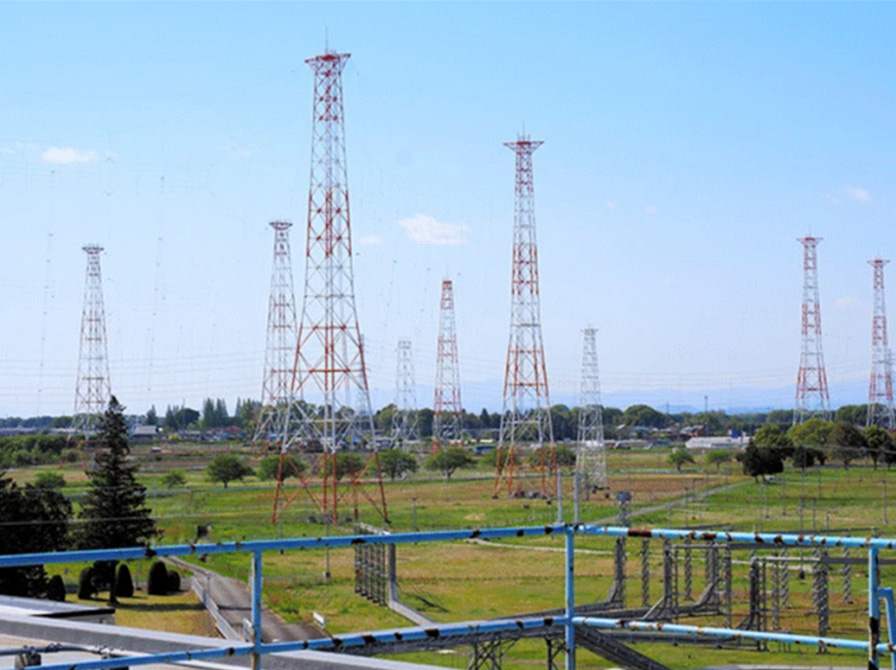
To broadcasting professionals, the Yamata Station is not merely a vast array of antennas; it is a strategic-level infrastructure that spans eras. Since its completion in 1940, it has been tasked with highly critical external broadcasting missions. From the "Radio Tokyo" broadcasts targeting Southeast Asia and the Pacific theater during the Pacific War, to the historic "Jewel Voice Broadcast" in 1945 that altered the course of history, the high-power shortwave facilities at Yamata have consistently served as Japan's core hub for external communication under extreme conditions.
Today, the Yamata Station still maintains several 300kW-class high-power transmitters and a massive curtain antenna array. In 2026, an era highly dependent on submarine optical cables, this transmitting station—with over 80 years of history—remains the Japanese government's ultimate physical safeguard for projecting electromagnetic signals globally directly from its home soil when all modern communication methods fail.
However, directly broadcasting via shortwave from the Japanese mainland to Tehran (a straight-line distance of approximately 7,600 kilometers) is not the optimal engineering solution. A span of over 7,000 kilometers entails 3 to 4 ionospheric hops. During the repeated processes of penetrating the D-layer and reflecting off the Earth's surface, the signal inevitably suffers from severe absorption loss and selective fading.
Therefore, modern international broadcasting has established a more resilient relay mechanism:
·Backbone Network Transmission: NHK's program audio is first converted into a digital stream and transmitted to a relay center in central France via deep-sea submarine optical cables (or backup satellite links if the cables are compromised).
·Radio Frequency (RF) Projection: The signal is taken over by Issoudun, the renowned transmitting center operated by TDF in France.
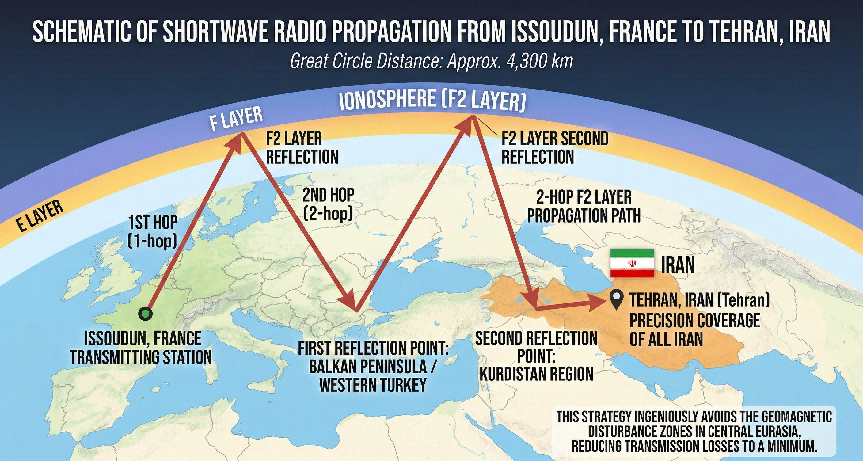
The great-circle distance from Issoudun to Tehran is approximately 4,300 kilometers. In radio propagation geometry, this constitutes a 2-hop F2-layer propagation path. The reflection point of the first hop is roughly located over the Balkan Peninsula or western Turkey, and the second hop is over the Kurdistan region, subsequently providing precise coverage across the entirety of Iran. This strategy ingeniously bypasses the geomagnetic disturbance zones in central Eurasia, minimizing transmission loss.
To ensure the signal possesses sufficient penetrating power in a war-torn environment potentially fraught with electronic jamming, the hardware parameters on the transmitting end must be pushed to the extreme.
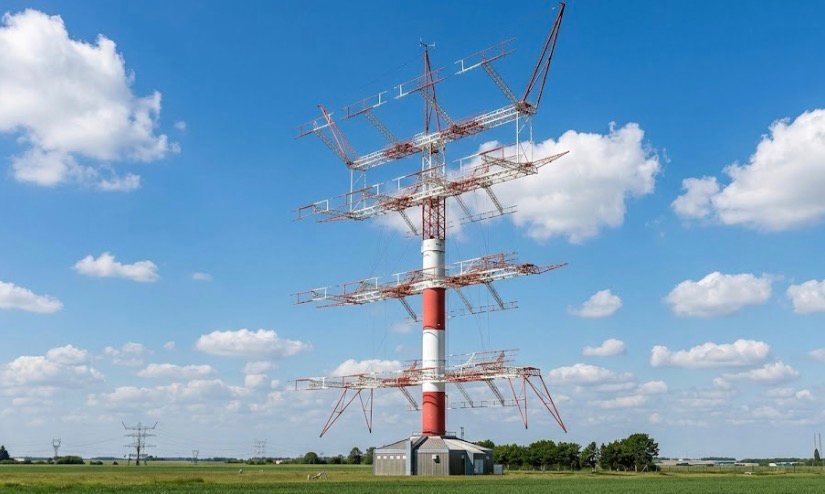
The Issoudun relay station utilizes the ALLISS antenna system (a rotatable curtain array), which weighs hundreds of tons and can rotate 360 degrees. When the 500kW transmitter power is fed into this high-gain antenna, its Equivalent Isotropically Radiated Power (EIRP) can reach an astounding magnitude of 50 megawatts (50,000kW).
We can briefly review the standard formula for calculating Free Space Path Loss (FSPL):
FSPL≈32.44+20log10(d)+20log10(f)
(Where d is the distance in kilometers, and f is the frequency in MHz).
Even factoring in nocturnal ionospheric absorption loss, relying on such a massive EIRP and an extremely narrow horizontal beamwidth (typically between 15° and 30°), the field strength upon arriving in Tehran can still easily penetrate standard air defense shelters or reinforced concrete buildings. This ensures that portable radios held by expatriates can stably lock onto the signal.
Modern cellular networks and two-way satellite communication systems rely on dense grids of ground base stations, space-borne transponders, and fiber-optic backbones. In environments characterized by physical conflict or large-scale power outages, these infrastructures are highly susceptible to destruction or active shutdowns. Furthermore, the operation of these systems relies on two-way handshake protocols and network authentication mechanisms; once local network nodes fail, end-user terminals are completely disconnected.
Shortwave broadcasting, employing high-power transoceanic transmission and ionospheric reflection propagation, is completely independent of any physical communication facilities within the target coverage area. It maintains the continuity of unidirectional information delivery even when local communication networks are paralyzed.
·Graceful Degradation: Under extreme physical conditions, traditional analog AM (Amplitude Modulation) demonstrates unique channel survivability characteristics. Faced with complex electromagnetic interference or urban ruins, high-frequency radio waves experience severe ionospheric multipath fading. However, when the signal-to-noise ratio (SNR) drops to extremely low levels, the demodulation quality of AM signals exhibits a smooth, graceful degradation. The human auditory system can still extract speech semantics from high background noise by relying on the surviving audio envelope.
·SDR and DSP Optimization: Combined with modern Software Defined Radio (SDR) reception architectures, terminals can directly sample via an Analog-to-Digital Converter (ADC) and run Synchronous AM (SAM) demodulation algorithms in the digital domain. This dynamically compensates for carrier distortion caused by ionospheric reflections, leveraging Digital Signal Processing (DSP) computing power to optimize the intelligibility of weak analog signals.
·Asymmetric Stealth: When cellular phones or satellite communication terminals connect to a network, they must emit uplink RF signals to establish communication. In areas subject to electromagnetic spectrum surveillance, these RF emissions directly expose the user's physical coordinates. Shortwave broadcasting possesses a purely unidirectional and passive physical nature. Terminal devices can operate independently relying on dry cells or physical hand-cranked generators. The RF acquisition and demodulation process generates absolutely no uplink radiation and requires no execution of network protocols. This asymmetric physical reception mechanism cuts off avenues for reverse location tracking, supporting the covert delivery of evacuation orders and safety advisories within specific regions.
The disruption of digital networks in 2026 serves as a wake-up call to all modern communication technologies. The Internet and Starlink are undeniably powerful, but they remain vulnerable in the face of physical destruction and electronic warfare.
Shortwave broadcasting—an "ancient" technology spanning over a century—utilizes the Earth's atmosphere as a natural reflector. Without needing to erect a single antenna on hostile territory, it achieves unstoppable information penetration. It may not represent the future of broadcasting technology, but in every darkest hour when base stations collapse and optical cables are severed, shortwave remains the final—and most robust—line of defense in humanity's communication network.


