





Phone:
+86-15928560945
On the afternoon of April 24, 2026, in Room 201C of the Beijing International Convention Center, during the CCBN “Multi-Channel Network Collaborative Development Forum,” the secretary of a subcommittee under the National Technical Committee of Auto Standardization stepped onto the stage and delivered a presentation titled “Standards and Key Technologies for In-Vehicle Wireless Broadcasting.”
This was his second time speaking at the forum. At the same time last year, he spoke about “government work arrangements and the initiation of a mandatory national standard.” One year later, what he brought was no longer an update on project approval, but a mid-term answer sheet for the standard development process.
The 22-month development cycle has already passed its 12th month. Three specialized technical meetings — covering antennas, EMC, and AM — have already been completed. Four full drafting group meetings and two core group meetings have also concluded.
The technical framework, in his own words, has “formed a relatively comprehensive standard technical framework.”
This means one thing:
The mandatory national standard that will determine what kind of radio receiver must be installed in newly manufactured vehicles in China from 2027 to 2035 has largely been settled at the technical level.
And in the framework that has now taken shape, there is no substantive place for the words “digital broadcasting.”
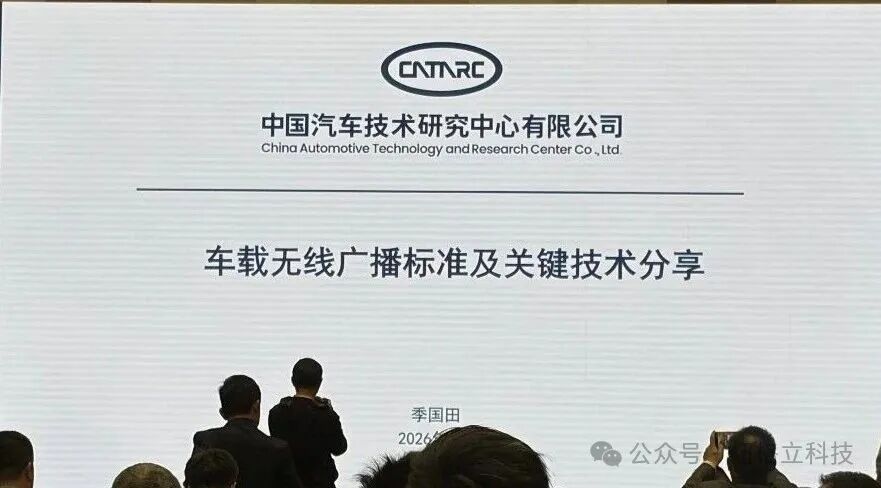
▲ Figure 1: The 2026 CCBN “Multi-Channel Network Collaborative Development Forum.” Presentation topic: “Standards and Key Technologies for In-Vehicle Wireless Broadcasting.” Of the 22-month development cycle, 12 months have already passed.
In 2023, the National Radio and Television Administration, the Ministry of Industry and Information Technology, and the State Administration for Market Regulation jointly issued a document to strengthen the management of in-vehicle audio and video systems and promote the installation and application of wireless broadcast receiving systems in vehicles.
On April 30, 2025, the mandatory national standard “In-Vehicle Wireless Broadcast Receiving System”, jointly proposed by the Ministry of Industry and Information Technology and the National Radio and Television Administration, was officially approved for development under project number 20251024-Q-339. The development cycle is 22 months, and the standard is expected to be completed and submitted for approval by February 28, 2027.
The drafting work was entrusted to the Electronics and Electromagnetic Compatibility Subcommittee of the National Technical Committee of Auto Standardization, namely SAC/TC114/SC29.
Participating organizations include technical institutions, research institutes, testing bodies, automakers, component suppliers, chip companies, and organizations from both the automotive and broadcasting sectors.
On stage, the secretary mentioned that the full drafting meetings were “basically attended by between 100 and 200 people.”
As of the presentation date, April 24, 2026, the drafting group had already held:
4 full drafting group meetings
2 core group meetings
3 specialized technical meetings
The specialized meetings focused on several key technical challenges: antennas, electromagnetic compatibility, AM reception in vehicles, and co-frequency interference between AM and electric vehicles.
The secretary displayed a “road so far” diagram marking the 12-month milestone. The yellow sections showed the work already completed, while the blue sections showed the remaining 10-month schedule.
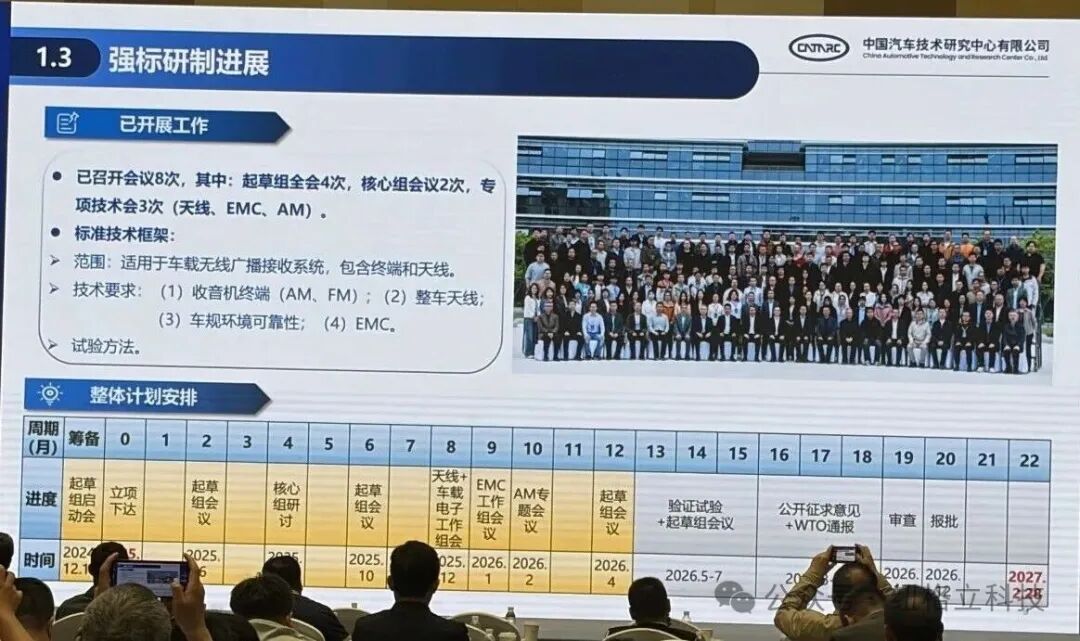
▲ Figure 2: The 22-month standard development timeline. Yellow indicates completed stages, from month 1 to month 12. Blue indicates the remaining 10 months, including verification tests, drafting group meetings, public consultation, WTO/TBT notification, review, and final submission. Screenshot from page 9 of the presentation slides.
The remaining schedule is as follows:
Verification tests and drafting group meetings, months 13 to 17
→ Public consultation and WTO notification, months 18 to 19
→ Review, months 20 to 21
→ Final submission, month 22
The public consultation and WTO notification stage roughly corresponds to October to November 2026.
This will be the final formal window during which the public and the industry can directly submit feedback to the standard drafting group.
There is nothing controversial in this section. It simply lays out the facts:
The process is more than halfway complete.
The technical framework has taken shape.
The remaining schedule is clear.
What comes next is the content of that technical framework.
In the second half of the presentation, the secretary moved into the “key technologies” section. This was the most information-dense part of the entire talk, and also the part most worth checking item by item.
Page 11 of the PPT showed the key technical framework of the “In-Vehicle Wireless Broadcast Receiving System” mandatory standard.
The framework is organized across six dimensions:
Functions
Performance
Test methods
Inspection rules
Same type determination
Standard implementation
Each dimension is further divided into sub-items.
If we extract only the “functions + performance requirements” column from this framework diagram, there are only seven labels:
Listening
Station search
FM
AM
Antenna
Environmental reliability
EMC
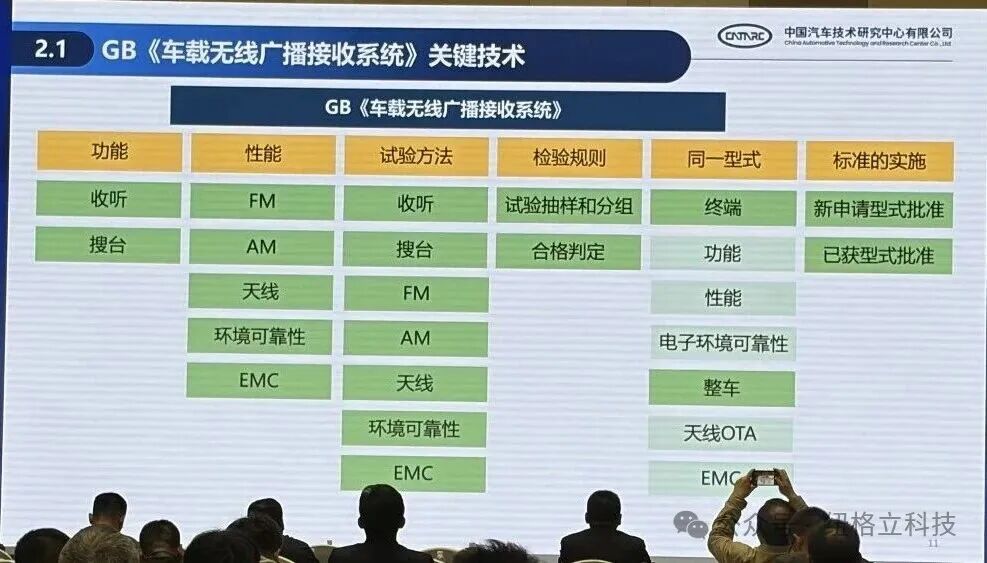
▲ Figure 3: Key technical framework of the mandatory standard for in-vehicle wireless broadcast receiving systems. The function and performance requirement dimensions cover only seven items: listening, station search, FM, AM, antenna, environmental reliability, and EMC. There is no digital broadcasting mode of any kind. Screenshot from page 11 of the presentation slides.
This is the entire content of the next eight years of in-vehicle broadcasting.
There is no CDR.
There is no DRM.
There is no digital audio broadcasting mode of any kind.
Page 13 of the PPT lists seven key technical indicators for AM terminals:
Frequency
o Start frequency ≤ 531 kHz
o End frequency ≥ 1602 kHz
Noise-limited sensitivity
o Measured at 603 / 999 / 1404 kHz
Signal-to-noise ratio
Selectivity
Automatic gain control
Total harmonic distortion
Overload distortion
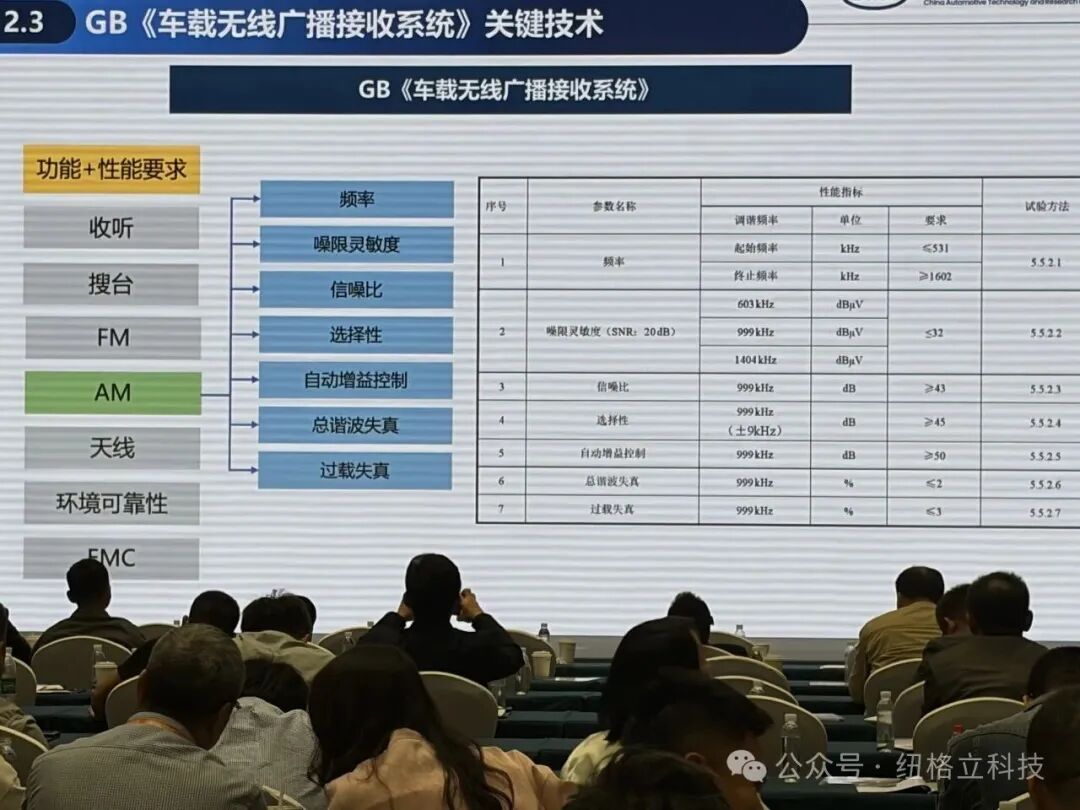
▲ Figure 4: Seven key technical indicators for AM terminals. Frequency range: 531–1602 kHz, the standard medium-wave broadcast band. Screenshot from page 13 of the presentation slides.
This is the standard medium-wave broadcasting band defined by the International Telecommunication Union in the 20th century.
It uses the same frequency range, the same envelope detection, and the same class of audio quality indicators as in-vehicle radios from the 1970s.
One point deserves special attention:
The operating modes of the DRM standard in the long-wave, medium-wave, and short-wave bands fully overlap with the AM frequency band of 531–1602 kHz.
Technically, same-frequency simulcast is entirely possible. That is, digital DRM and analog AM can be transmitted simultaneously on the same frequency, with the receiver identifying and selecting the appropriate signal.
India’s All India Radio has already operated 33 medium-wave transmitters in this mode for years.
But the AM section of the in-vehicle mandatory standard does not require receivers to have DRM digital demodulation capability.
Page 12 of the PPT lists 11 key technical indicators for FM terminals:
Frequency
Noise-limited sensitivity
Signal-to-noise ratio
Dual-signal selectivity
AM suppression ratio
Total harmonic distortion
Overload distortion
Frequency response
Stereo separation
Stereo signal-to-noise ratio
Stereo distortion
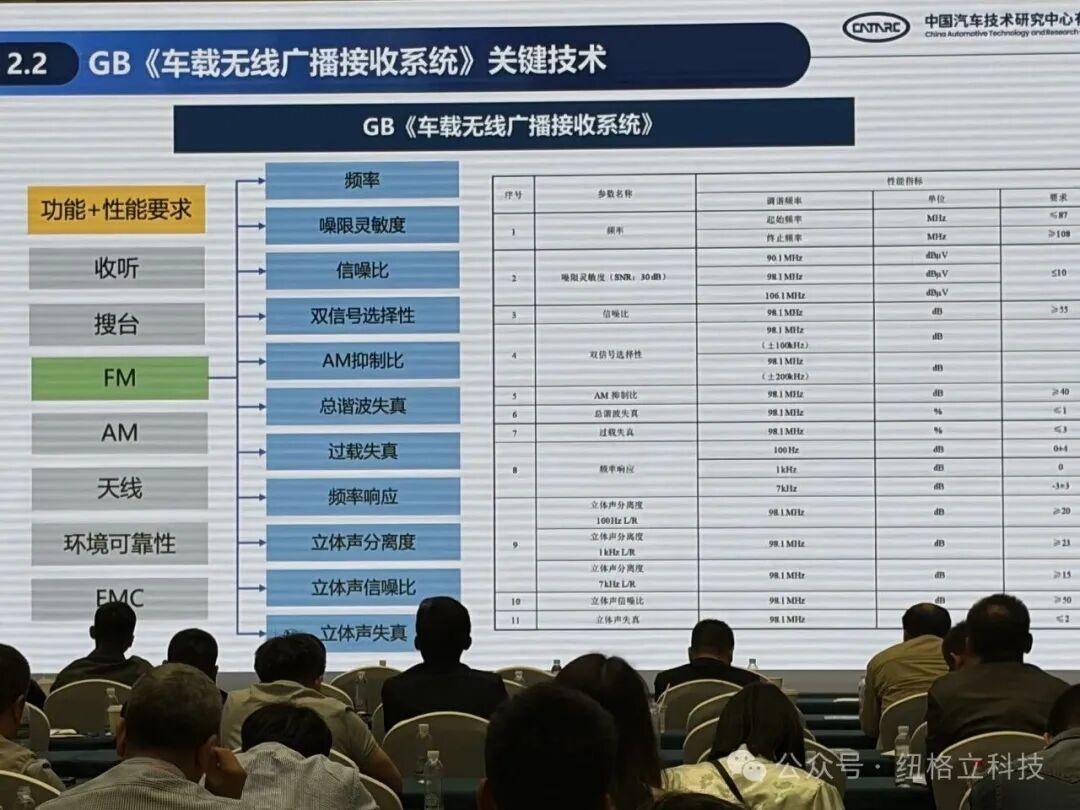
▲ Figure 5: Eleven key technical indicators for FM terminals. All of them are analog stereo broadcasting parameters. Screenshot from page 12 of the presentation slides.
All 11 parameters are analog stereo broadcasting parameters.
There is no reception performance requirement for CDR, China’s digital audio broadcasting system in the FM band.
CDR operates in the 87–108 MHz FM band, also known as VHF Band II, fully overlapping with the existing FM frequency range.
CDR was designed from the beginning to coexist with existing analog FM through simulcast.
Yet the FM section of the in-vehicle mandatory standard likewise does not require receivers to support CDR digital demodulation.
If we translate these parameter tables into business terms, the conclusion is this:
The mandatory national standard will be issued in February 2027.
Based on the typical lifecycle of mandatory national standards, usually five to ten years, all new vehicles manufactured for the Chinese market from 2027 to 2035 will be required by the state to carry the following in-vehicle broadcast receiving capabilities:
Analog AM.
Analog FM.
Not DRM.
Not CDR.
And not even any mandatory clause requiring a future upgrade interface for digital reception.
This is an eight-year analog lock-in period.
This is the most important factual point in the article.
China’s CDR standard system did not start late.
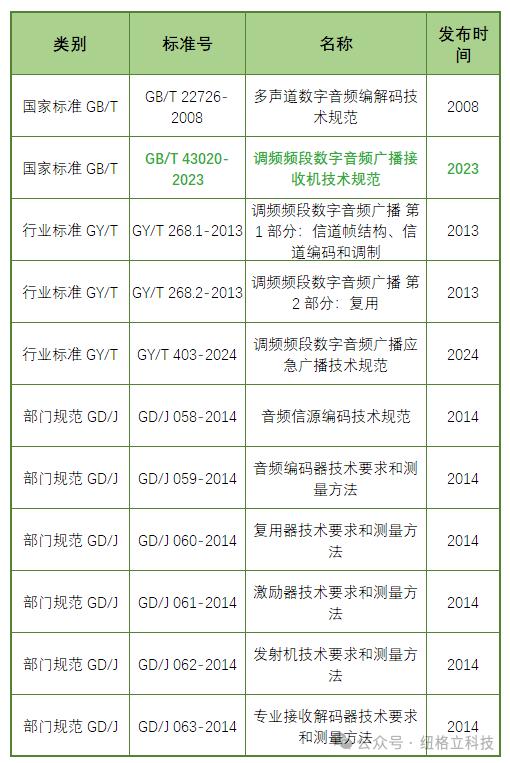
From the first national standard for audio coding in 2008, the complete industrial-chain standard matrix for CDR has been gradually built over 16 years.
As of April 2026, the published standards and specifications include a complete chain:
Source coding
→ Encoder
→ Multiplexing
→ Multiplexer
→ Exciter
→ Transmitter
→ Professional receiving decoder
→ Receiver
→ Emergency broadcasting
This is a complete industrial-chain standard matrix.
It covers the entire chain from program production to signal transmission, from professional front-end equipment to mass-market receivers.
And the decisive standard among them, GB/T 43020-2023 Technical Specification for Digital Audio Broadcasting Receivers in the FM Band, is a recommended national standard for ordinary consumer receivers, including car radios. It was published in 2023.
Let us place the timeline side by side:
2023: GB/T 43020-2023 was published.
April 30, 2025: The mandatory national standard “In-Vehicle Wireless Broadcast Receiving System” was officially approved for development.
This means that at the moment the in-vehicle mandatory standard project was launched on April 30, 2025, the drafting group already had before it a recommended national standard, published one and a half years earlier, specifically defining technical specifications for CDR receivers.
According to the usual practice of China’s national standard system, referencing or converting clauses from a recommended national standard into a mandatory national standard is an institutional action with almost zero technical workload.
Adding one paragraph after the FM section, for example:
“For in-vehicle receivers equipped with CDR reception capability, the CDR receiving performance shall comply with GB/T 43020-2023.”
This would not require the drafting group to conduct new technical research.
But it did not happen.
In the version of the technical framework that has now taken shape, the CDR slot has been deliberately left blank.
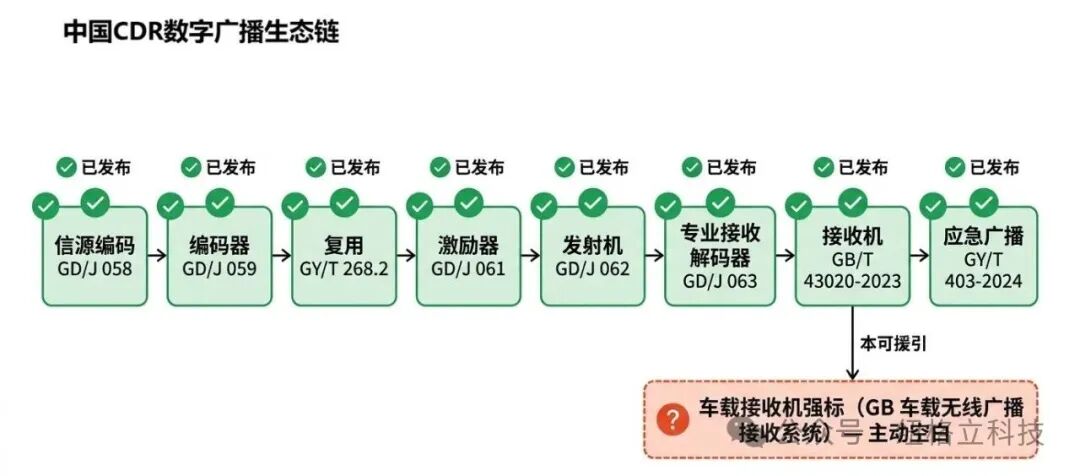
▲ Figure 6: CDR standard matrix. Eight links, from source coding to emergency broadcasting, have already been covered by national standards, industry standards, or departmental specifications. At the receiver level, GB/T 43020-2023 was already published in 2023. Yet the 2027 version of the in-vehicle mandatory standard has chosen to leave this link blank.
This changes the answer space to the question:
Why is digital broadcasting not included?
It is no longer possible to simply say, “the technical specifications are immature” or “there is no document to reference.”
Those two explanations are undermined by the very existence of GB/T 43020-2023.
This is an explicit choice.
As for the judgments and constraints behind that choice, this article will discuss them later.
At the beginning of the presentation, the secretary emphasized:
“We should particularly recognize the important strategic role of in-vehicle wireless broadcasting systems in emergency rescue and in conveying the voice of the state.”
Before entering the technical parameter section in the second half, he expanded on the same argument in more concrete terms:
“Wireless broadcast receiving terminals have unique advantages in actively delivering sudden natural disaster alerts, such as earthquakes and floods, as well as other safety information to drivers and passengers. When cellular base stations are damaged by sudden emergencies such as earthquakes, floods, and typhoons, the wireless broadcast receiving terminal in the vehicle plays a critical role.”
This argument is completely valid.
In earlier articles on the Warsaw Radio Mast, the silence and restart of shortwave broadcasting, and the return of shortwave from Ukraine to Iran, we repeatedly examined the same set of facts:
Broadcast infrastructure is significantly more disaster-resistant than cellular networks. Under disaster conditions, broadcasting is one of the few information channels that can still function.
But the emergency capability of analog AM and FM broadcasting has clear boundaries.
Analog AM/FM signals can only carry audio.
They cannot carry structured warning data, such as:
Text
Coordinates
Multilingual switching markers
Emergency severity levels
They cannot wake up a silent receiver when the vehicle is turned off.
Analog broadcasting requires the RF front end and demodulation chain to remain continuously powered. It has no low-power standby wake-up mechanism.
It also cannot push information to a specific geographic area.
Analog broadcasting has no service information data channel and therefore cannot identify the service area in which the receiver is located.
These capabilities are native to digital broadcasting standards such as DRM and CDR.
The DRM standard, including ETSI ES 201 980 and related ETSI TS 102 821, includes EWF, or Emergency Warning Functionality.
It can wake up a receiver from standby mode when the vehicle is off, automatically switch to an emergency channel, automatically increase volume, and deliver multilingual audio and text.
CDR also supports emergency broadcasting functionality.
This has become a consensus in the international broadcast engineering community over the past 15 years:
Digital broadcasting is a natural carrier for emergency broadcasting.
China’s own standardization work in this field has already gone quite deep.
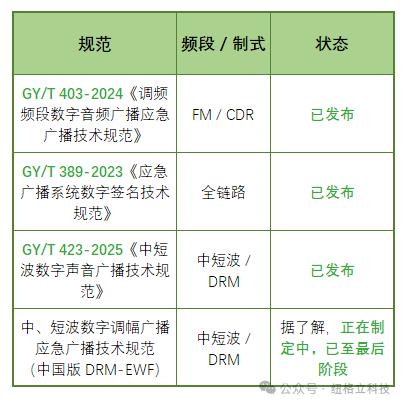
The meaning of this matrix is clear:
China’s broadcasting system is systematically building a Chinese digital broadcasting emergency specification matrix.
It covers both the FM band, through CDR-EWF, and the medium-wave and short-wave bands, through DRM-EWF.
GY/T 403 and GY/T 423 have already standardized the transmitting end, signal format, emergency message encapsulation, digital signature verification, and related elements.
Once the forthcoming technical specification for emergency broadcasting over medium-wave and short-wave digital amplitude modulation broadcasting is released, China’s digital broadcasting emergency specification matrix will be largely closed.
But there is one gap in this matrix that has not yet been closed:
The vehicle end.
GY/T 403 specifies how CDR emergency broadcast signals should be transmitted.
GB/T 43020-2023 specifies how CDR receivers should receive them.
From the program source to the transmitting end and then to the receiving end, the chain is already closed at the standards level.
Only the 2027 version of the in-vehicle mandatory standard does not connect to this chain.
This creates an internal tension within the standard system:
On the broadcasting side: resources are being invested to build a digital broadcasting emergency specification matrix, including three already published standards, one forthcoming standard, and GB/T 43020-2023 as the receiver national standard.
On the vehicle side: the mandatory national standard clearly does not require access to this emergency capability.
To put it plainly:
“Emergency broadcasting is a national lifeline” and “vehicles are not required to receive emergency signals” are two voices pointing in opposite directions within the same national standard system.
This section places China’s in-vehicle broadcasting situation in a global context.
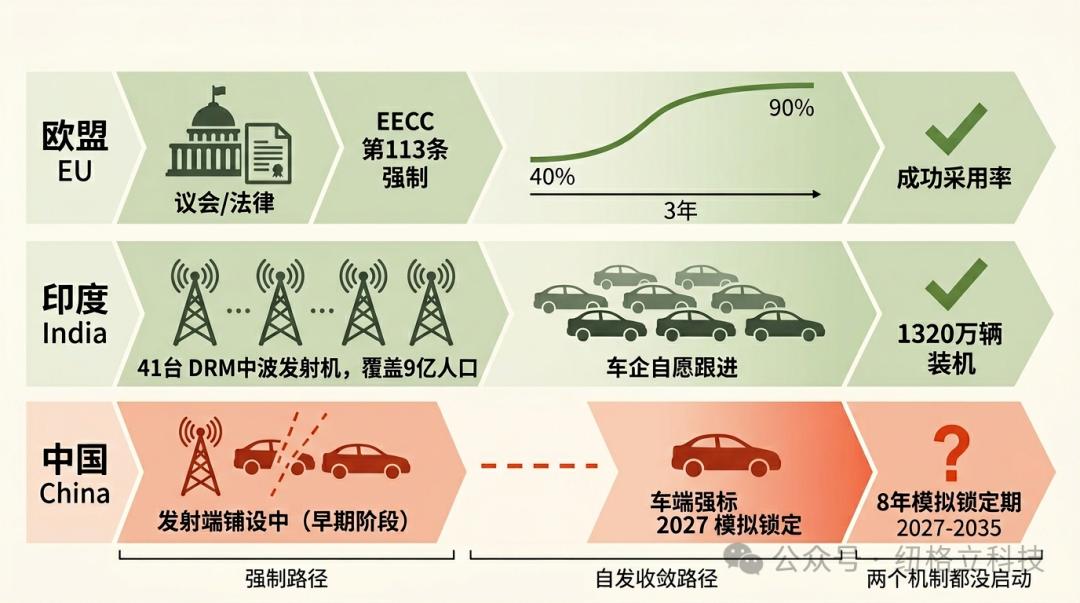
▲ Figure 7: Three paths. Europe used mandatory regulation to reverse the market within three years. India relied on transmitter-side deployment first, allowing the market to converge spontaneously. China has not activated either of these two market-driving mechanisms.
In December 2018, the European Union passed the European Electronic Communications Code, or EECC.
Article 113 states that from December 2020 onward, all new cars sold in the EU market, if equipped with a radio receiver, must be capable of receiving digital terrestrial radio, namely DAB+.
The cleverness of this rule lies in the fact that it does not force automakers to install radios.
But it blocks the downgrade path of installing only analog FM radios.
Once a vehicle is equipped with a radio, it must support digital reception.
The effect was immediate and dramatic.
France had long been one of Europe’s most passive markets toward digital broadcasting. Before the regulation came into effect, the standard installation rate of DAB+ in new cars was below 40%.
Within three years of the regulation taking effect, the DAB+ standard installation rate in new cars in France exceeded 90%.
In countries such as Poland, Czechia, and Spain, where DAB+ deployment had previously been almost nonexistent, the standard installation rate of DAB+ in new cars exceeded 90% in the first year.
The logic is simple.
For automakers, maintaining two different SKUs across the entire EU market — one with digital radio and one without — is far more expensive than making digital radio standard across the board.
Once the regulation says, “if installed, it must support digital,” full-line standard installation becomes the most economical engineering choice.
One regulation, three years, and the entire European in-vehicle broadcasting ecosystem was reversed.
India chose the completely opposite path.
There was no mandatory regulation.
Yet as of early 2026, more than 13.2 million passenger vehicles on Indian roads were equipped with DRM digital radio receivers.
Maruti Suzuki, Hyundai, Tata, Mahindra, MG, Toyota, Mercedes-Benz — almost all major brands selling vehicles in India participated in this silent installation wave.
How did this happen?
The answer is that All India Radio, or AIR, first built the signal coverage.
Starting from zero, AIR deployed 41 high-power DRM medium-wave transmitters and 2 DRM short-wave transmitters within five years, covering a population of more than 900 million.
Four major cities — Delhi, Mumbai, Kolkata, and Chennai — have already achieved full-time pure digital DRM broadcasting.
After the transmitting end was deployed first, the automakers’ cost calculation changed.
The incremental cost of adding a DRM chip is low, but it enables vehicles to receive a noticeably better broadcast experience than analog AM:
Digital audio quality
Multiple program services
Text information
Station identification
In a market where the signal already covers 900 million people, not installing the receiver becomes a competitive disadvantage.
Together with the local design and production of NXP’s SAF4000 series chips in India, and the fact that the same hardware can support DRM, CDR, and DAB through software configuration, the core triangle of the Indian model is:
Transmitter-side deployment first.
Localized chip supply.
Reusable software-defined hardware.
The figure of 13.2 million vehicles was not created by policy compulsion.
It was the result of spontaneous market convergence.
Now place Europe and India side by side, and then look at China.
The mandatory path:
Europe reversed the market through Article 113 of the EECC.
China’s 2027 version of the mandatory standard clearly does not require digital broadcasting.
The spontaneous path:
India relied on AIR’s signal deployment first, allowing the market to converge on its own.
China has published the transmitter-side standard GY/T 423-2025, has a plan to upgrade 600 stations, and already has seven DRM short-wave transmitters in operation.
But the deployment of medium-wave DRM is still in its early stage, far from the scale of India’s “900 million people covered” model.
China’s unique situation is this:
The three-way deadlock that Europe solved through mandatory regulation — automakers lacking motivation, users lacking demand, and broadcasters lacking content — still exists in China.
The transmitter-side coverage density required for India’s “signal first, market follows” path will likely take China another five to ten years to reach.
If both paths fail to work, the result is an eight-year analog lock-in period.
It is not that India can do something China cannot.
It is that China has chosen a path that neither relies on compulsion nor can currently rely on spontaneous market convergence.
And at the moment, this path has no visible convergence point.
The development of a mandatory national standard is serious national work.
The constraints faced by the drafting group are far greater than what outside observers can see.
Any external observation should leave room for these constraints.
Possible explanations include the following.
If the in-vehicle mandatory standard requires CDR reception, there may be an awkward situation in which the receiver can demodulate CDR but cannot find a signal.
This is a real engineering concern.
But thinking in the opposite direction, the Indian model proves that “having receivers first and then forcing signal coverage to follow” can also work.
The key question is whether the policy signal is consistent.
GY/T 423-2025 was published in July 2025.
The plan to upgrade 600 stations is still in its launch period, overlapping with the 22-month development cycle of the in-vehicle mandatory standard.
Standard setters may choose to “wait until the transmitting end is ready before writing receiving requirements.”
But this waiting has no clear deadline.
The full name of SAC/TC114/SC29 is the Electronics and Electromagnetic Compatibility Subcommittee.
Its scope is naturally closer to environmental durability, electromagnetic compatibility, and automotive-grade requirements for low-voltage components in automotive electronics.
It is not inherently responsible for RF physical-layer broadcasting standards.
Within a 22-month development cycle, coordinating across technical committees and working with broadcasting-sector standards committees to reference GB/T 43020-2023 would involve non-negligible institutional coordination costs.
This explanation is relatively weaker.
At CCBN 2026, Chengdu Newglee Technology released a full-chain solution for in-vehicle digital broadcasting reception.
Based on a general-purpose ARM embedded platform, it implements complete DRM / CDR / FM / AM reception through software, proving that the industry chain can already support preparation for automotive-grade mass production.
However, the scaling up of chip production still requires order pull from automakers, and there is a timing-matching issue.
These four explanations all have some validity.
But one counter-question must be faced:
If GB/T 43020-2023 has already defined all technical parameters for CDR receivers, then the in-vehicle mandatory standard only needs to add one referencing clause after the FM section.
The technical workload is almost zero.
The reasonable explanation space for “why not reference it” has become significantly narrower than it was at the start of the 22-month development cycle.
This is especially true for the first and second explanations — insufficient signal-side coverage.
Insufficient signal coverage does not constitute a reason for not writing receiver capability requirements at all.
The standard could be written as:
“In-vehicle receivers shall be equipped with CDR reception capability, but activation shall not be mandatory during the transition period.”
Or:
“In-vehicle receivers should be equipped with CDR reception capability as a recommended clause.”
These are common forms of phased implementation wording in China’s national standard system.
Using “wait until the signal side is ready” as a reason for not writing receiving capability into the standard is equivalent to permanently freezing the chicken-and-egg problem on the side of “wait for the chicken first.”
Page 7 of the PPT clearly marked the remaining 10-month schedule.
Months 18 to 19 are the public consultation and WTO/TBT notification stage, roughly corresponding to October to November 2026.
This is the final window for public participation.
There are two kinds of input space during this stage:
Any professional institution, enterprise, industry association, or individual can submit feedback to the drafting group.
Through the WTO Technical Barriers to Trade notification mechanism, international peers and foreign-invested enterprises can also submit opinions.
So what opinions should be submitted?
In several previous articles, we repeatedly argued for a seemingly counterintuitive judgment:
Strong commitments are cheaper than weak commitments.
This judgment also applies to the current revision of the in-vehicle mandatory standard.
A possible clause could be written as follows:
“If a new vehicle is equipped with a wireless broadcast receiving device, it shall support at least one of the following digital broadcasting systems:
1. Digital Audio Broadcasting in the FM band, CDR, with receiving performance compliant with GB/T 43020-2023;
2. Digital sound broadcasting in the medium-wave and short-wave bands, DRM, with receiving performance compliant with the relevant provisions of GY/T 423-2025.
Mandatory implementation date: 24 months after the publication date of this standard.”
This clause may look stricter than the FM/AM sections, but in fact it is the lowest-total-cost path for automakers.
There are three reasons.
Weak commitment merely distributes the cost into the hedging investments of every automaker.
In a state of “maybe it will be mandatory, maybe it will not,” every automaker is forced to prepare two paths at the same time:
One cost-optimized plan without digital broadcasting.
One emergency plan in case digital broadcasting later becomes mandatory.
Finance departments cannot include digital reception capability as a definite input in BOM planning.
Upstream chipmakers do not dare to scale production.
Content providers do not dare to invest in CDR data broadcasting.
Everyone waits.
Waiting itself is a cost.
Once a strong commitment is made, the hedge disappears, and everyone can shift resources into productive work.
This was the real mechanism behind the reversal of Europe’s in-vehicle broadcasting ecosystem within three years after EECC Article 113 took effect.
In the Chinese market, mainstream automakers sell hundreds of thousands to millions of vehicles per year.
If the mandatory standard only says “recommended” or “suggested,” the optimal strategy for automakers is to configure the lowest-cost SKU, namely, not installing digital broadcasting.
If the mandatory standard says “if installed, it must support digital,” the optimal strategy becomes full-line standard installation of the same infotainment motherboard integrated with DRM/CDR support.
The incremental cost of a 50–100 RMB digital broadcasting module, distributed across a market of 30 million vehicles per year, is far cheaper than maintaining two supply chains for “installed” and “not installed” SKUs.
HD Radio has been approved by the FCC since 2002, but its penetration rate has long stagnated.
The root cause is the word “voluntary.”
Broadcasters say:
“There are no listeners with HD radios. Why should I spend money upgrading?”
Automakers say:
“There are no stations broadcasting HD programs. Why should I add cost by installing HD modules?”
Consumers say:
“I don’t know what HD Radio is.”
This three-way deadlock can only be broken by a strong commitment.
If the 2027 version of China’s in-vehicle mandatory standard lists CDR/DRM as “recommended rather than mandatory,” the foreseeable result is a Chinese replay of HD Radio’s 23-year fate in the United States.
One line of thinking goes like this:
“Implement it in stages. First write it as a recommended clause, then upgrade it to mandatory once transmitter-side coverage improves.”
This sounds reasonable within the national standards system.
But in the specific context of China’s in-vehicle broadcasting, it has one unavoidable problem:
The assumption of “spontaneous market follow-up” does not hold in China.
India’s model of “no mandate plus 13.2 million installed vehicles” worked because AIR had already deployed 41 medium-wave DRM transmitters covering 900 million people, with four major cities broadcasting full-time pure digital DRM before the vehicle side took action.
Only after the signal side was ready did “adding one DRM chip” become an engineering action with real user-perceived value for automakers.
China’s transmitter-side situation is different.
GY/T 423-2025 was only published in July 2025.
The 600-station upgrade plan is still in its launch stage.
If the vehicle side uses “recommended” instead of “mandatory” at the same time, then:
Automakers will not install it voluntarily, because signal-side coverage is not yet sufficient to support user-perceived value.
The signal side will not accelerate construction, because the receiver-side market lacks a clear expectation.
This is the worst equilibrium in a coordination game:
Both sides wait for each other, and neither moves.
Treating “recommend first, mandate later” as a gradual path may look prudent in engineering terms.
But in game-structure terms, it freezes the chicken-and-egg problem forever on the side of “wait for the chicken first.”
The likely outcome of the gentle path is not a gradual upgrade that starts slow and then accelerates.
It is more likely to be:
“Recommended for five years, installed by no one, and when the mandatory standard reaches its next revision cycle, this slot is still empty.”
If the first strong constraint option — “if a radio is installed, it must support digital reception” — is considered too difficult for the drafting group to push through in the remaining 10 months, the main objection will probably be:
“Signal-side coverage is still insufficient. Forcing reception capability now will create the awkward situation of installed receivers that cannot receive signals.”
This objection has engineering logic.
But strong commitment has more than one form.
There is another wording that avoids the signal-coverage objection while still being a strong commitment:
Hardware-Ready, Software-Activatable.
It does not require new vehicles to immediately provide digital broadcasting reception.
But it mandates that the hardware must have all the conditions needed for future activation via OTA.
The clause can be divided into four elements:
“If a new vehicle is equipped with a wireless broadcast receiving device, it shall meet the following hardware conditions:
1. The tuner shall have digital baseband I/Q output capability and comply with the digital interface specifications of mainstream automotive-grade tuner chips;
2. The overall hardware design shall retain the signal path from the tuner digital baseband to the main processor;
3. The main processor shall have sufficient computing capability to support CDR or DRM digital broadcasting software decoding, with the capability to support at least one system through software decoding;
4. The vehicle infotainment system shall support OTA upgrades of the wireless broadcasting software module.”
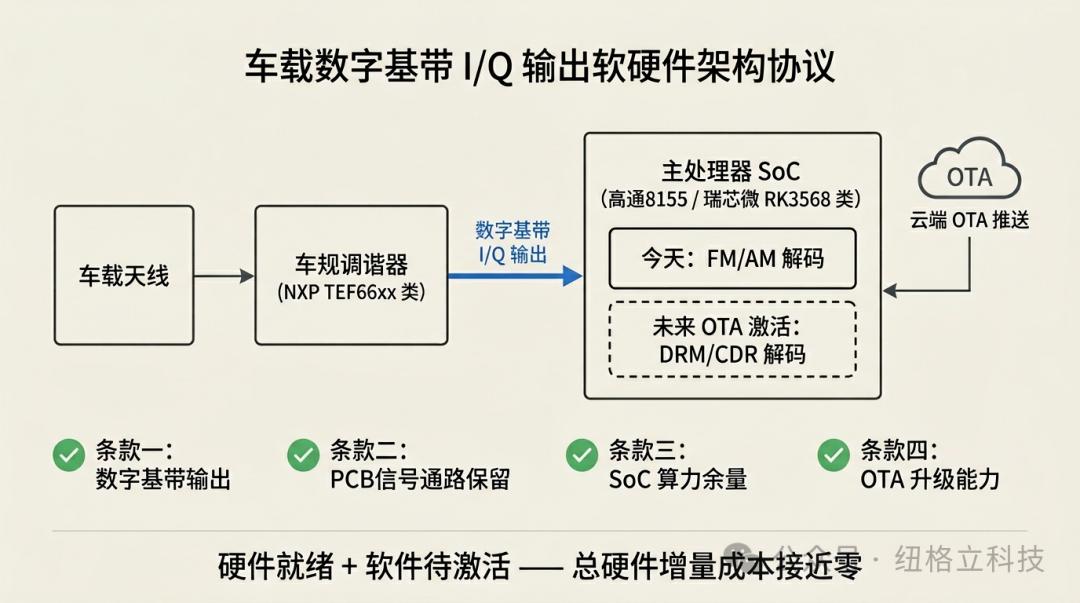
▲ Figure 8: The four elements of the hardware-ready clause: tuner I/Q digital baseband output, PCB signal path retained to the SoC, sufficient SoC computing headroom, and OTA upgrade capability. DRM/CDR decoding is not required to be activated today, but the hardware downgrade path is blocked.
Individually, none of these four conditions is demanding.
Mainstream automotive-grade tuners, including the NXP TEF66xx series, ST, Silicon Labs, and others, mostly already adopt digital IF architectures.
I/Q digital baseband output is a capability that these chips already have.
In some low-cost configurations, the pins are simply not brought out.
Mandating that the digital baseband interface be brought out has almost no cost impact on tuner selection or BOM.
Connecting this signal path to the SoC during PCB design has no material cost difference compared with not connecting it.
The difference lies in whether the system can later be rescued through OTA.
If connected, it can be rescued.
If not connected, it is permanently disabled.
Mainstream automotive infotainment SoCs — such as Qualcomm 8155, Rockchip RK3568, and Huawei Kirin series chips — have computing power far beyond what is required for DRM/CDR software decoding.
Chengdu Newglee Technology’s full-chain SDR solution has already proven that complete DRM/CDR/FM/AM reception can be implemented in software on a general-purpose ARM embedded platform, without relying on any dedicated digital broadcasting chip.
Automakers only need to confirm at the SoC selection stage that the computing power is sufficient to carry future digital broadcasting software decoding.
For the vast majority of vehicles mass-produced after 2027, this condition is already satisfied by default.
For new energy vehicle brands and most joint-venture brands, this is already standard.
For some traditional automakers, it may be a new requirement.
But it is fully aligned with China’s current policy direction on automotive software upgrades, information security, and connected vehicles.
Taken together, the total hardware incremental cost of this clause is close to zero.
In essence, it does not require “installing a new chip.”
It requires automakers not to actively destroy digital broadcasting capability during PCB design and SoC selection.
Yet its commitment strength is on the same level as “if a radio is installed, it must support digital reception.”
It blocks the hardware downgrade path of “even if we want to install it in the future, we cannot.”
It ensures that during the eight-year analog lock-in period, the hardware capability for digital reception is not lost.
Once transmitter-side coverage improves, or once policy adjustment requires activation of digital reception, automakers would only need to push an OTA software package to activate the function.
No recall.
No hardware replacement.
No need to wait for the next-generation vehicle platform.
This clause also carries another layer of policy significance:
It transforms the objection of “insufficient signal-side coverage” into a positive industrial pull mechanism.
When 30 million new vehicles per year all have hardware-ready capability for DRM/CDR activation via OTA, transmitter-side construction will face a receiver market with clear expectations.
This certainty will in turn accelerate:
The upgrade of 600 stations under the GY/T 423-2025 plan
The deployment of CDR signal sources by local broadcasters
The movement of the entire digital broadcasting ecosystem toward an activation point
And this is worth serious consideration by the drafting group:
The hardware-ready clause is the easiest strong-constraint form to reach consensus under the current political-economic constraints.
It does not directly conflict with the engineering reality of insufficient signal-side coverage.
It does not require automakers to pay cash today for a function no one currently uses.
It gives all opposing parties a face-saving step.
At the same time, it does the one thing that actually matters:
It ensures that the eight-year analog lock-in period does not become an irreversible hardware lock-in.
If “shall support CDR or DRM” is the Chinese version of the European blocking logic, then “hardware-ready plus OTA activation” is a strong-commitment path better suited to China’s current conditions.
The two are not a “main option versus fallback option.”
They are two different forms of strong commitment.
The drafting group may choose either.
But it should not choose the weak-commitment wording of “should support.”
The cost of weak commitment has already been discussed above.
During the remaining 10 months, the groups that can meaningfully speak during the consultation process are mainly the following.
They have the strongest say on the real incremental cost of “installing one digital broadcasting chip.”
They can puncture the public claim that mandatory installation would significantly raise vehicle prices.
They hold GB/T 43020-2023, the GY/T 268 series, GY/T 403-2024, and GY/T 423-2025.
Referencing these standards is an institutional action. It does not require new technical research.
Opening the vehicle-end market would turn the “planned demand” for upgrading 600 transmitter stations into “pulled demand.”
For domestic substitution in medium-wave and short-wave transmitters, exciters, antenna-feeder systems, emergency broadcasting head-end equipment, monitoring equipment, and related areas, this would create a real growth window.
Companies such as Chengdu Newglee, which have already developed full-chain SDR solutions, can use product and cost data to prove that the industry chain is already prepared.
They best understand the real value of EWF and multilingual emergency broadcasting.
They can connect the policy narrative of “emergency broadcasting as a national lifeline” with the technical requirement that “vehicles must be able to receive it.”
They can explain the lessons from Europe’s EECC, India’s AIR, and America’s HD Radio more clearly, providing decision-makers with a fuller international coordinate system.
The public consultation window is open to all these voices.
The question is not whether opinions can be submitted.
The question is whether anyone will actually submit them.
This article is not an accusation.
The development of a mandatory national standard is serious national work.
All materials used in this article come from the public presentation and public slides at the CCBN Multi-Channel Network Collaborative Development Forum on April 24, 2026.
These were materials visible to anyone attending the forum.
The core purpose of this article is to place the already-formed technical framework, the already-published related standards, and the international experience already accumulated side by side, so that the discussion during the remaining 10-month window can take place on a more complete factual basis.
China has already invested significant resources in digital broadcasting on the transmitter side and in emergency broadcasting specifications:
GB/T 43020-2023
The GY/T 268 series
GY/T 403-2024
GY/T 423-2025
The forthcoming technical specification for emergency broadcasting over medium-wave and short-wave digital amplitude modulation broadcasting
These represent the results of 16 years of standardization work.
The vehicle end is the final link in this long chain.
How this link is written into the standard — whether as a strong constraint of “shall support,” a weak commitment of “should support,” or left blank altogether — will determine far more than the choice of a single technical parameter.
It will determine whether the in-vehicle broadcasting capability of 300 million new vehicles in China over the next eight years can align with the digital networks being deployed on the transmitter side and with the emergency broadcasting specification matrix being built during the same period.
Strong commitments are cheaper than weak commitments.
That is the sentence this article wants to leave for the remaining 10-month window.
There is still half a year before the public consultation window in October to November 2026.
All factual materials in this article come from the public presentation and public slides at the CCBN Multi-Channel Network Collaborative Development Forum on April 24, 2026.
Information regarding the progress of the technical specification for emergency broadcasting over medium-wave and short-wave digital amplitude modulation broadcasting is based on industry understanding and is treated in this article with qualifiers such as “it is understood.”
Any judgment on the direction of standard development represents the author’s observation only and does not constitute an accusation against the standard-setting authorities.
