




Phone:
+86-15928560945
After the tube era came to an end, what should be done with a 2 MW medium-wave transmitting station?
In 2017, Hungary provided an answer — and it was the first of its kind in the world.
The Solt transmitting station is located on the plains along the Danube River in central Hungary, about 100 kilometers from Budapest. It serves Kossuth Rádió, the most-listened-to radio channel in Hungary. The station operates on 540 kHz with a power output of 2 MW, or 2,000 kW.
What does 2 MW mean in practical terms? In China, most medium-wave stations operate at power levels between 10 kW and 200 kW. Solt is ten times more powerful than a 200 kW station. It is currently the most powerful medium-wave transmitting station in Europe and one of the most powerful medium-wave stations still in operation anywhere in the world. Other stations in the same class include the 2 MW station at Duba in Saudi Arabia and Hungary's own Soviet-built equipment used before 1977.
The transmitting antenna is a 303.6-meter-high guyed mast, operating as a quarter-wave vertical radiator. At 540 kHz, the full wavelength is approximately 555 meters, and a quarter wavelength is about 139 meters. However, the physical height of 303.6 meters is greater than a quarter wavelength. This design helps optimize low-angle radiation and expand ground-wave coverage.
The station was built in 1977 and served as a core part of Hungary's broadcasting infrastructure during the Cold War. The original transmitting equipment consisted of two Soviet-made 1 MW tube transmitters connected in parallel to produce a combined output of 2 MW. These two machines operated continuously for 40 years.

▲ Image: The 303.6-meter guyed mast of the Solt transmitting station standing on the Hungarian plain.
How old were these two Soviet tube transmitters? Their design dates back earlier than many transmitters still in service today in some countries.
Forty years means the original manufacturer no longer existed. The Soviet Union dissolved in 1991, and spare parts had to be sourced from old stock in warehouses across former Soviet countries. Every replacement became a gamble. The tubes were custom-made, with no standard off-the-shelf substitutes. Prices rose year by year, while quality became increasingly unreliable, since many of these tubes were themselves decades-old inventory.
Engineers capable of maintaining such equipment were also disappearing. Soviet tube transmitters had their own maintenance logic and operating habits. These were not found in Western textbooks, nor were they taught in Hungarian university courses. The knowledge existed in the hands-on experience of senior engineers. Every retirement meant the loss of a piece of irreplaceable technical memory.
The efficiency problem became impossible to ignore at the 2 MW level. The overall efficiency of a tube transmitter is roughly 50% to 60%. Taking 55% as a middle value, producing 2 MW of RF output requires about 3.6 MW of electrical power. Of that, roughly 1.6 MW becomes heat — carried away by cooling water, blown out by ventilation fans, or absorbed by the walls of the transmitter hall. Based on Hungarian industrial electricity prices, the wasted electricity alone represented a six-figure annual cost in euros.
In 2013, the Hungarian government listed the entire Solt transmitting station as a protected industrial heritage site. The underlying message was clear: the historical value of the Soviet equipment had already exceeded its practical value.
But Hungarian Radio had no intention of shutting down the station.
They planned to replace its heart.
Hungary's national broadcast infrastructure operator, Antenna Hungária, chose the Canadian company Nautel to carry out the upgrade. Nautel's solution was to replace the Soviet tube transmitters with five NX400 solid-state transmitters, combined through a dedicated 2 MW combining system known as the NXC2000.
The NX400 was Nautel's flagship medium-wave transmitter at the time. Each unit was rated at 400 kW and was fully solid-state. Five units at 400 kW each add up to 2,000 kW, exactly meeting the 2 MW requirement. But combining multiple transmitters is not simply a matter of arithmetic.
Five RF signals must be merged into a single output. Their amplitude and phase errors must be tightly controlled. If the phase of any one path deviates by more than a few degrees, the combined power will drop. If the deviation becomes larger, reflected power may damage the equipment. The core function of the NXC2000 combiner is to ensure that all five signal paths are precisely aligned at the combining point.
The redundancy design is even more important. The NXC2000 supports N+1 operation. If any one of the five NX400 transmitters fails or is taken offline, the combiner automatically reconfigures the power distribution among the remaining four units to maximize output at the antenna. This process requires no manual intervention and no interruption to broadcasting.
This means that after the upgrade, the Solt transmitting station actually became more reliable than it had been in the Soviet era. The original two 1 MW tube transmitters did not have this kind of automatic degradation capability. If either one failed, the station's output power was immediately cut in half.
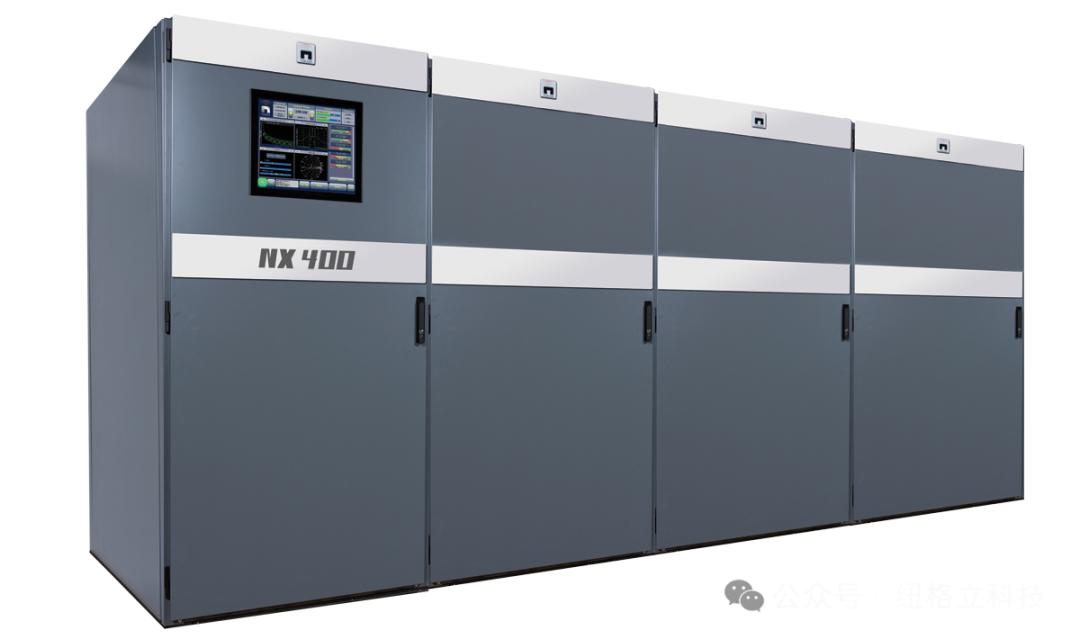
▲ Image: Nautel NX400 transmitter. Modular power amplifier architecture with hot-swappable support.
The upgrade was completed in 2017. Several engineering details are worth highlighting.
The antenna remained unchanged.
The 303.6-meter guyed mast continued to be used without modification. The RF output characteristics of the solid-state transmitters — including impedance, frequency response, and harmonic suppression — were compatible with the existing antenna and feeder system. This is extremely important in medium-wave station upgrades. The antenna and tower base are among the most expensive assets of the entire station. Altering the antenna would be equivalent to rebuilding the station. Solt proved that switching from tube transmitters to solid-state transmitters on the same antenna was feasible.
The transmitter hall was reused.
The new equipment was installed inside the existing transmitter hall and coexisted with the Soviet equipment during a transitional period. A single NX400 cabinet is much smaller than a Soviet tube transmitter. The combined footprint of five NX400 transmitters plus the NXC2000 combiner was less than half that of the original equipment. The freed-up space has since become part of the industrial heritage exhibition at the Solt station.
Efficiency improved dramatically.
The NX400 has an overall efficiency of more than 90% at full power. Moving from approximately 55% efficiency with the Soviet tube transmitters to 90% efficiency means that, for the same 2 MW RF output, total electrical consumption dropped from around 3.6 MW to about 2.2 MW. That is a continuous power saving of approximately 1.4 MW. Based on 18 hours of operation per day and an industrial electricity price of about €0.10 per kWh in Hungary, the annual electricity saving is approximately €920,000. This figure alone would be enough to recover the full equipment purchase and upgrade cost within a few years.
DRM-ready capability.
The NX400 natively supports DRM30 digital radio broadcasting. After the solid-state upgrade, the Solt station gained the hardware capability to broadcast DRM digital radio on 540 kHz. Kossuth Rádió still broadcasts in traditional AM mode, but if Hungary decides to promote medium-wave digital broadcasting in the future, Solt will not need another equipment replacement.
After the upgrade, Solt's coverage did not shrink. In fact, it improved in some respects. The modulation accuracy and spectral purity of the solid-state transmitters are better than those of the tube transmitters, especially under extreme low-modulation and high-modulation conditions. Distortion is lower, and intelligibility in fringe coverage areas has improved.
Reports from DX enthusiasts — long-distance radio reception hobbyists — provide a more direct demonstration of the station’s coverage capability. Kossuth Rádió’s signal on 540 kHz has been reported as received in Michigan in the United States and Kuala Lumpur in Malaysia. The former is about 7,500 kilometers from Solt, while the latter is about 9,500 kilometers away.
The signal of a Hungarian medium-wave station being captured on the other side of the world is the physical reality of 2 MW medium-wave broadcasting.
The reference value of the Solt story for domestic medium-wave station engineers does not lie in its power level. Most domestic stations operate between 10 kW and 200 kW, far below 2 MW. Its real value lies in answering a core question:
When tubes are no longer available, what is the way forward for high-power medium-wave stations?
The answer is clear: modular solid-state replacement.
Solt used five 400 kW modules to build a 2 MW system, proving that this path is viable even at an extreme power level. For stations in the 10 kW to 200 kW range, fewer modules are required, system complexity is lower, and the upgrade difficulty is far less than that of Solt.
The Solt experience also proves three key assumptions: the antenna can be retained, the transmitter hall can be reused, and the switchover can be completed without interrupting broadcasting. If these three conditions hold — and they did at Solt — then solid-state upgrading is not a matter of tearing everything down and rebuilding from scratch. It is more like replacing the heart while preserving the body.
Solt's Soviet tube transmitters ran for 40 years. Under the combined pressure of spare-part depletion, loss of technical personnel, and low efficiency, the station eventually completed its transition.
Some domestic stations using imported tube transmitters have also been in service for 20 to 30 years and are facing a similar pressure curve.
The difference is this:
Hungary began the upgrade while the tubes were still available.
They did not wait until the last tube burned out.
