




Phone:
+86-15928560945
We often discuss what DRM can do, how to use it, and how much it costs. But rarely do we ask the more fundamental question: Where did this technology actually come from?
The birth of DAB is well-known—it emerged from the European government-funded Eureka 147 project, starting at Munich’s IRT in 1981, costing 93 million euros and taking 13 years to reach ITU standardization.
The story of DRM, however, is seldom told. It wasn't the byproduct of a government master plan, a university thesis, or a bolt from the blue. Its DNA comes from two competing prototype systems, spurred by the anxiety of international shortwave broadcasters losing their audience, and shaped by a technical tug-of-war between French and German engineers. Ultimately, it took just five years—one-third the time of DAB—to go from concept to ITU standard.
This is a story of how technology is born through competition and compromise.
In the early 1990s, international shortwave broadcasting was in decline. Giants like the BBC World Service, Deutsche Welle, Radio France Internationale, and the Voice of America—who relied on shortwave to project their voices globally during the Cold War—faced a shared dilemma: the sound quality of analog AM shortwave was abysmal. With channel bandwidths of only 9kHz or 10kHz, ionospheric multi-path fading, and adjacent-channel interference, listeners were fleeing. FM and the nascent internet were devouring shortwave’s audience.
Meanwhile, the success of the Eureka 147 DAB project offered inspiration: OFDM and digital audio coding could transmit high-quality sound over harsh wireless channels. But DAB was designed for VHF/UHF with a 1.5MHz bandwidth—shortwave channels were barely one percent of that size. Could a similar logic be "squeezed" into 9kHz?
Two groups of engineers began experimenting almost simultaneously.
T2M: The German Route (1996) Deutsche Telekom and Telefunken (now Transradio) collaborated on a system called T2M. Their approach was conservative: using single-carrier APSK (Amplitude Phase Shift Keying) within a 10kHz bandwidth to carry both digital and traditional analog AM signals simultaneously. In April 1996, at the Jülich Shortwave Center in Germany, they completed the world’s first digital shortwave trial broadcast.
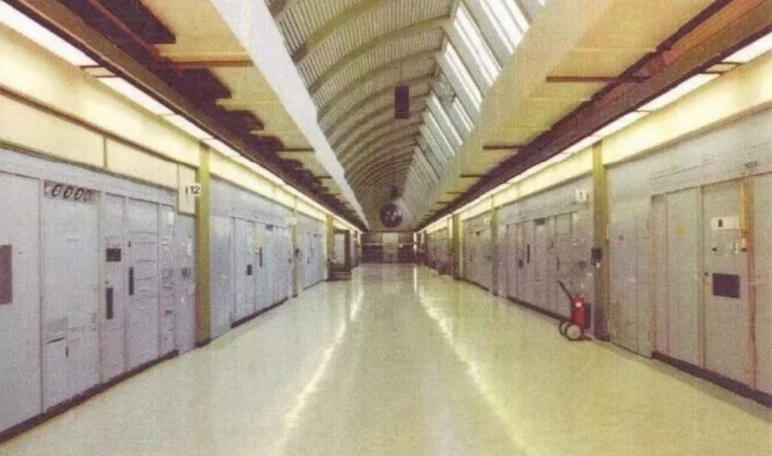
Caption: The transmitter hall of the Jülich Shortwave Center (Kurzwellenzentrum Jülich). In April 1996, the world's first digital shortwave trial broadcast was completed here. The center was demolished in 2010. (Source: Wikimedia Commons)
In 1997, at the IFA consumer electronics show in Berlin, the T2M team demonstrated the first digital shortwave receiver prototype — a modified Blaupunkt car radio.
Skywave 2000: The French Route (1997) Almost simultaneously, France’s Thomcast (the broadcast division of Thomson-CSF, later Thales) took a completely different path. Their system, Skywave 2000, centered on COFDM (Coded Orthogonal Frequency Division Multiplexing)—the same modulation family as DAB, but redesigned for extreme narrow-band shortwave. In 1997, they performed a stunning demonstration: transmitting a digital signal from the Issoudun station in central France via ionospheric skywave reflection to a receiver at an international convention.
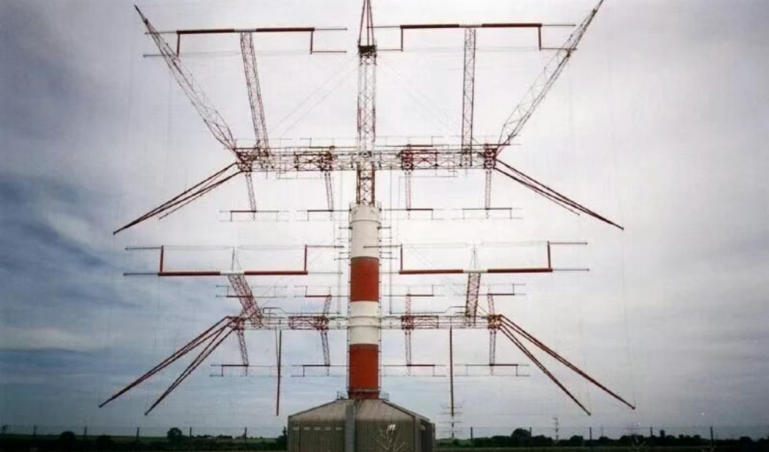
▲ The "Gange" ALLISS rotating antenna at the TDF Issoudun shortwave station, photographed in 2002. From here, the first public demonstration of Skywave 2000 was transmitted in 1997. Issoudun is one of the world's largest shortwave broadcasting stations. (Source: Wikimedia Commons)
This was the world’s first successful digital shortwave broadcast using real skywave propagation. It was not a laboratory simulation, not a short-range ground-wave test, but a genuine digital shortwave signal — bounced off the ionosphere.
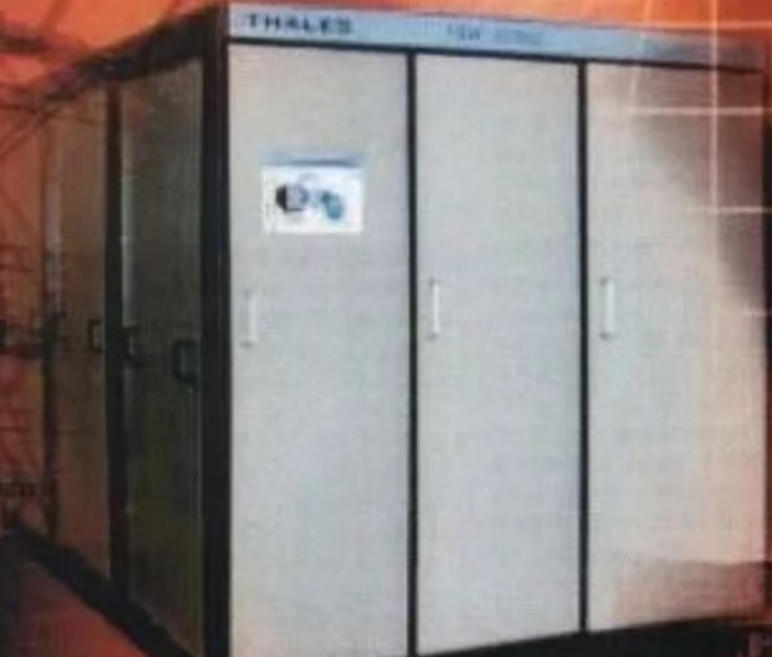
▲ Thomson TSW 2250D — the first dual-mode (analog/DRM) high-power shortwave transmitter, developed by Thomcast. The TRE 2355 used in the Skywave 2000 demonstration was an early model from the same product line. (Source: transmitter.be)
As the two prototypes advanced, political integration began. In September 1996, an informal meeting was held in Paris. Representatives from Deutsche Welle, RFI, TDF, VOA, Deutsche Telekom, and Thomcast realized that if Germany and France launched incompatible standards, the result would be a total failure for both. By the second Paris meeting in November, they settled on a name: Digital Radio Mondiale. "Mondiale" was chosen (French/Italian for "worldwide") to signal that this was a global standard, not a national one.
On March 5, 1998, the DRM Consortium was officially formed in Guangzhou, China. The founding lineup was prestigious: broadcasters like the BBC and VOA, manufacturers like Thomcast and Harris, and electronics giants like Sony.
Why Guangzhou? Because DRM didn't want to be labeled a "European standard." Launching in China sent a clear signal: this was a global standard for nations in Asia, Africa, and Latin America that still relied heavily on AM/shortwave.
The Consortium's first major decision was choosing between T2M’s single-carrier APSK and Skywave 2000’s multi-carrier COFDM. After a year of debate, COFDM won. It offered superior resistance to the multi-path fading inherent in shortwave and allowed engineers to reuse the tools and experience gained from DAB.
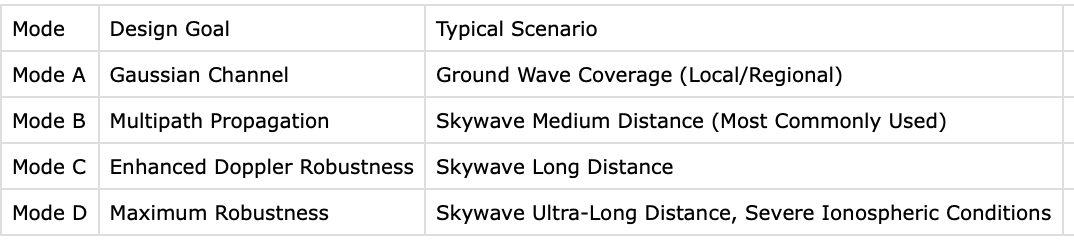
Thomcast/Skywave 2000's technical approach became the foundation of the DRM transmission layer. The modulation scheme was defined as three levels — 64-QAM, 16-QAM, and 4-QAM — and four robustness modes were designed to adapt to varying propagation conditions:
DRM took only five years (1996–2001) to reach ITU standardization, compared to DAB’s 13 years. While DAB was a grand "start-from-scratch" research project, DRM was more of an "emergency application port"—retooling proven COFDM technology for the extreme constraints of the shortwave channel.
From the first official broadcast at WRC-03 in Geneva to the evolution of audio codecs (from AAC to HE-AAC and finally to the mandatory USAC in 2014), DRM has never stopped refining its efficiency. It later expanded to the VHF band (DRM+), offering a digital alternative for FM.
Looking back over 25 years, DRM was born of anxiety and compromise. Its biggest hurdle has always been the lack of mass-market consumer receivers. However, that narrative is changing. As digital radio becomes a standard feature in new vehicles—particularly in markets like India and China—the "receiver problem" is finally being solved. The dream that began on a circuit board in Jülich in 1996 is finally finding its way into every car, every tunnel, and every emergency broadcast.


